Exploring the visual art scene of Norway's southwest coast ➜ Since 2015
The Cory Arcangel Hack: Stepping outside the rules of engagement
Eivind Røssaak's The Cory Arcangel Hack: Digital Culture and Aesthetic Practice, recently released by MIT Press, explores the dominant arrangements in Cory Arcangel’s artistic practice. Arcangel, famed for his computational art works, has been based in Stavanger for the past decade. Below, the concluding chapter from Røssaak's book, which examines the social and political ramifications of Arcangel’s art, is reproduced in its entirety.
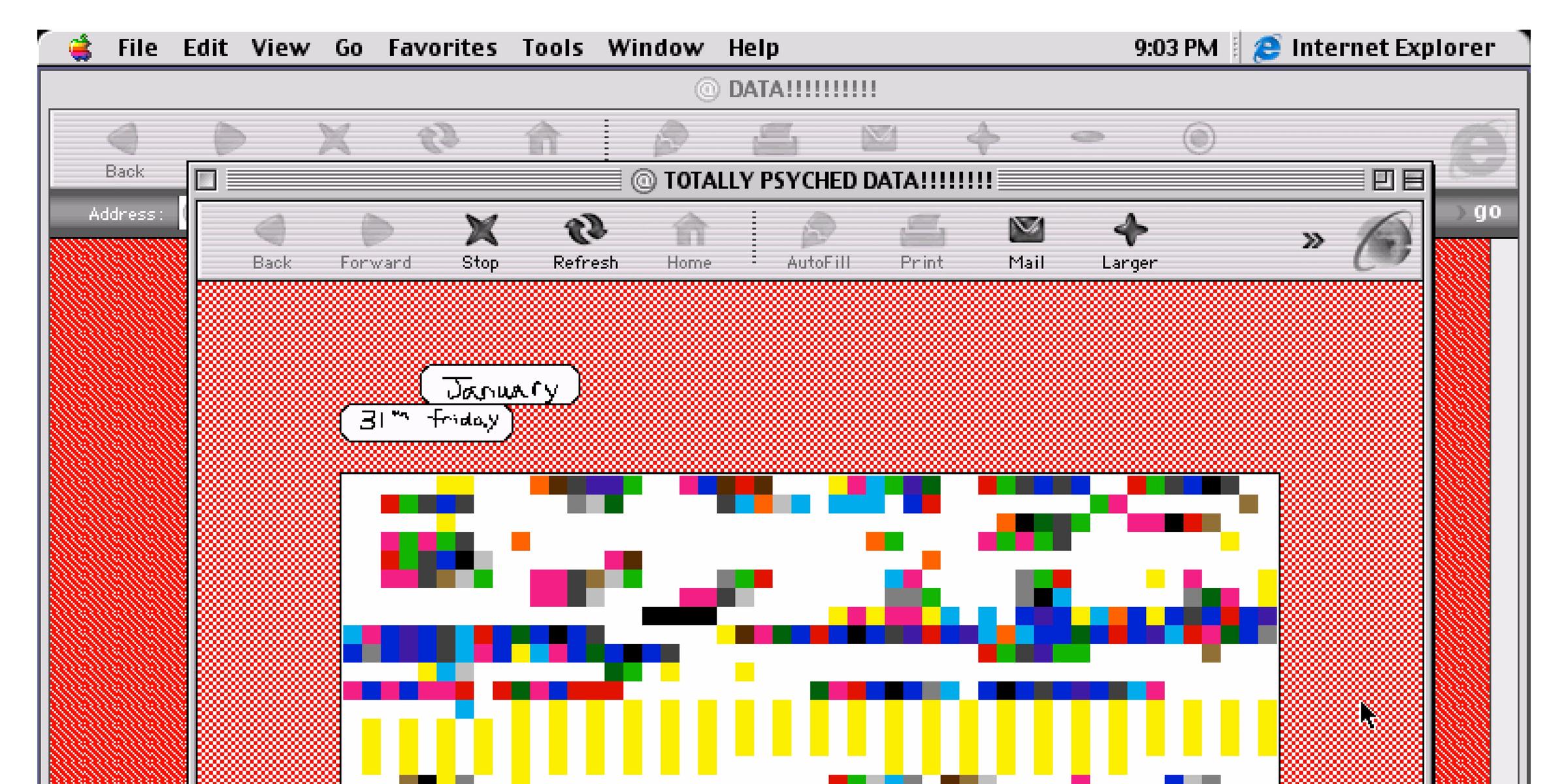
Cory Arcangel. Data Diaries, 2003. Video installation, 62 single- channel videos (optional selection). Photo: Cory Arcangel. Courtesy: the artist, Rhizome. Historically accurate screen shot created using bwFLA, Emulation as a Service, University of Freiburg. Data Diaries is a commission of New Radio and Performing Arts, Inc., dba Ether—Ore, for its Turbulence web site. It was made possible with funding from the Jerome Foundation.
The Hack as Social Invention
“You always hope there is more but maybe even I sometimes hope there is less, because if there is nothing, there is even more. Do you understand what I mean?” —Cory Arcangel C. Arcangel, “Introduction to the Weekend at Bernie’s performance and screening,” lecture, Whitney Museum of American Art, 2011, video, Arcangel’s archive.
The Cory Arcangel hack examines the forces, flows, and rhythms operating within a machinic milieu. It is precise, targeting just a fragment of a larger eco-operational territory. In the introduction, I called Arcangel the “mechanologist,” envisioned by Gilbert Simondon, who explores how humans and machines converge and individuate into new technical milieus. However, unlike Simondon, who focuses on evolution, resolution, and adoption, Arcangel’s work instigates anomalies, failures, disequilibrium, and maladaptation. His hack draws upon the energy of confrontation, contempt, and humor inherited from Duchamp and the avant-garde tradition, to explore a diverse array of flow-cut arrangements within a new machinic milieu.
Arcangel reconnects the art world to a contemporary condition that is often ignored or avoided in mainstream art.
Arcangel reconnects the art world to a contemporary condition that is often ignored or avoided in mainstream art. However, instead of ridiculing the art world as a “white cube” isolated from broader realities, he maintains faith in the art exhibition as an “other place” or heterotopia, a space that offers a unique vantage point from which to interrogate and engage with the world in novel and transformative ways.M. Foucault, “Of Other Spaces,” Diacritics 16, no. 1. (Spring 1986). The exhibition space becomes a site for dissecting and isolating flows lifted from their eco-operational environment governed by the laws of Big Tech, to reexamine them. Arcangel revitalizes the question: What can art do to a body of flows? While similar explorations have been undertaken by many artists before him, Arcangel employs different methods, “sculpting” videos with bots, code, and graphics ripped from a toxic media ecology. Drawing on the avant-garde tradition as a toolbox, his flow-cut arrangements liberate matters of expression— often in fun and gimmicky ways—where the forces and energies between media systems and the art world are renegotiated.
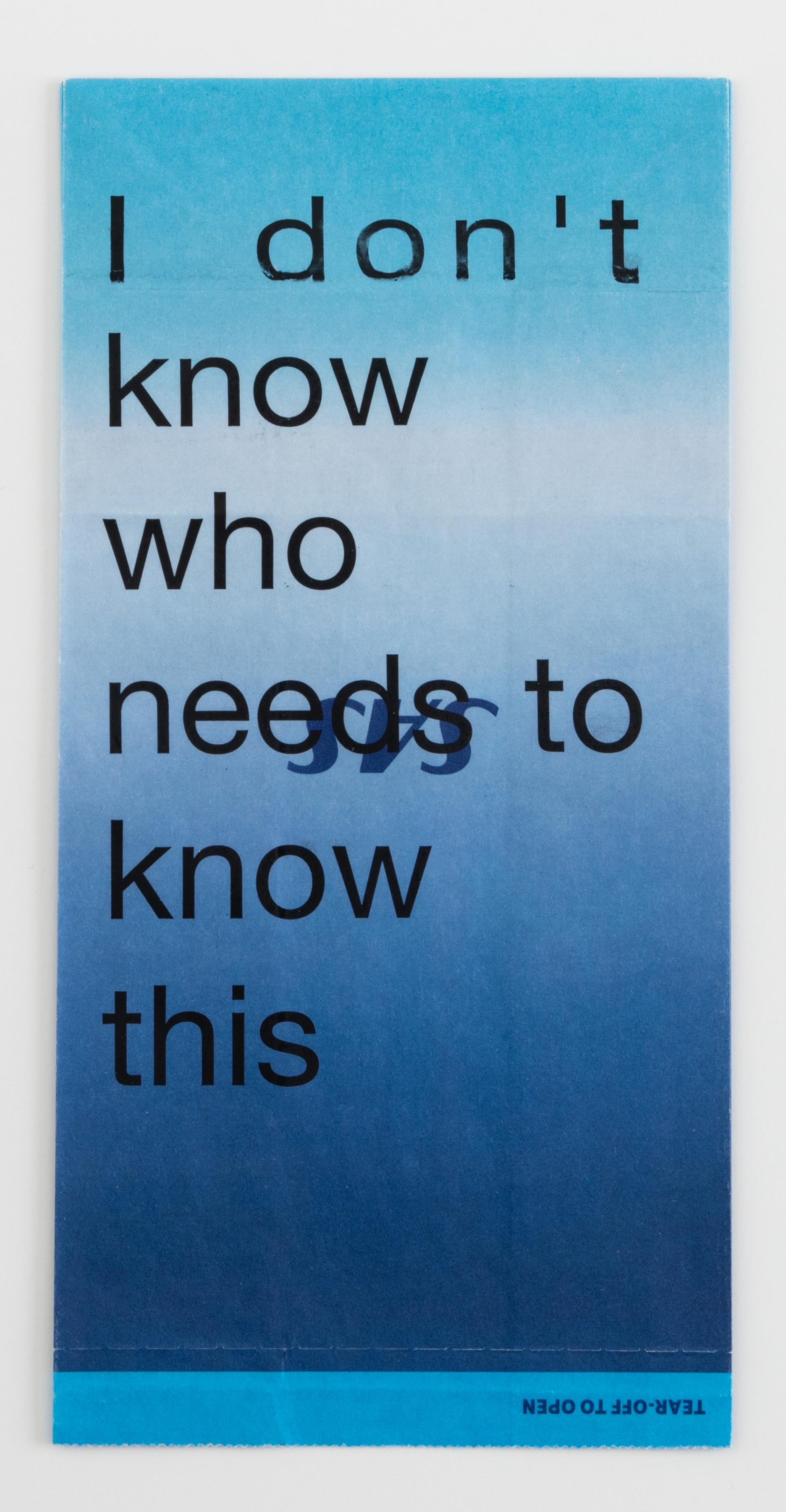
Cory Arcangel. I don't know who needs to know this, 2020. Hewlett Packard home office LaserJet on found Scandinavian Airlines vomit bag. Photo: Zeshan Ahmed. Courtesy: the artist, Greene Naftali Gallery.
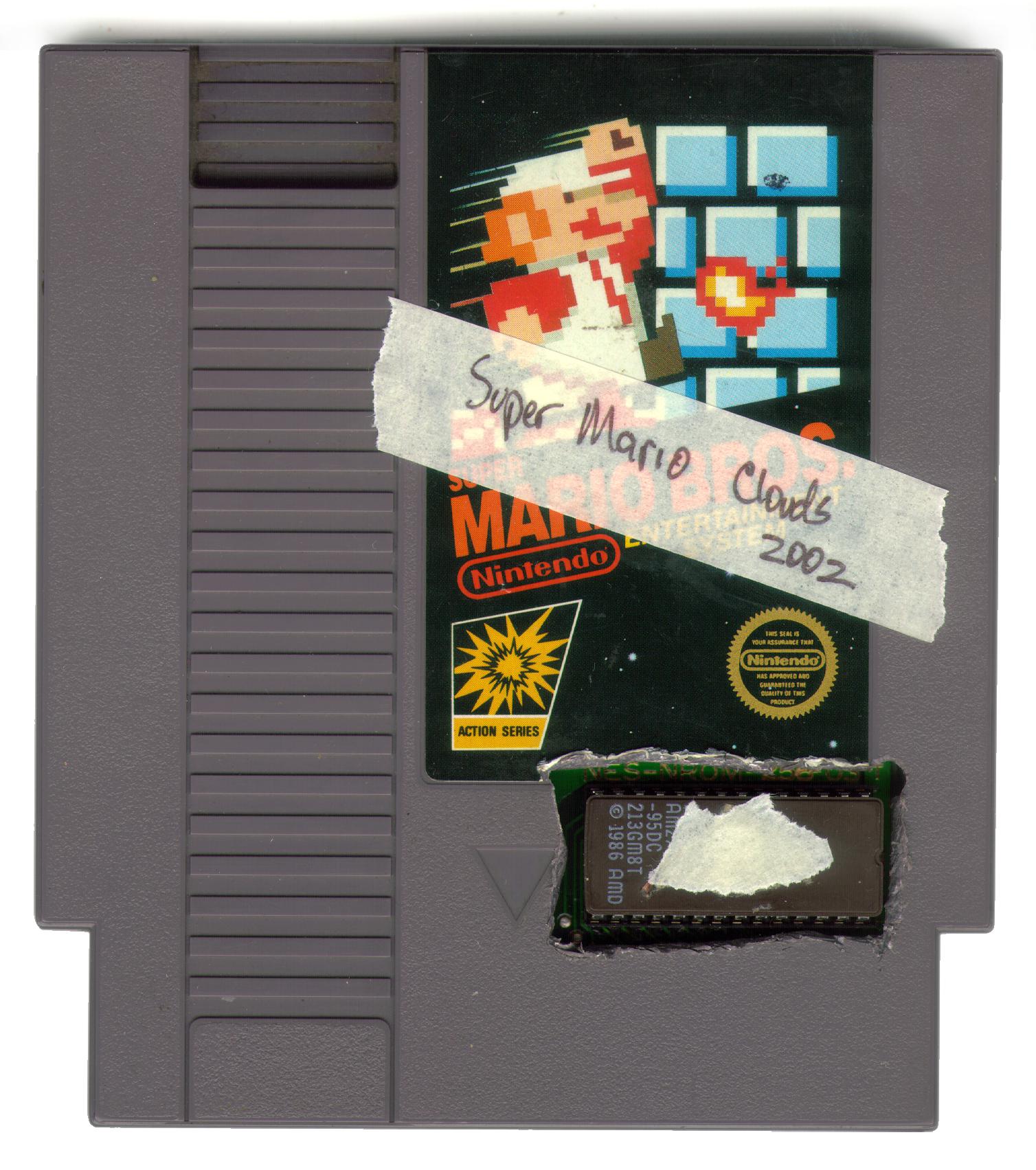
Cory Arcangel. Super Mario Clouds, 2002. Handmade hacked Super Mario Bros. cartridge, Nintendo NES video game system, artist software. Photo: Cory Arcangel. Courtesy: the artist.
Resistance
Arcangel’s art engages with the habitual ways in which human expressions and sense-perceptions (aisthesis) are facilitated, shaped, and captured by processes of infrastructuration implemented in interfaces, affordances, software, algorithms, and larger systems. He challenges the efficacy of media systems. His cuts and modifications playfully de-express expressions, de-control control, and de-participate participation. They create meaning through non-sense, in the double meaning of “sense,” which encompasses both the exploration of new sensory compositions and the development of novel forms of knowledge with and through machines.M. Fuller and E. Weizman, Investigative Aesthetics: Conflicts and Commons in the Politics of Truth (Verso, 2021). Sense perception, and sense-ability takes place with machines and the machinic. The Cory Arcangel hack creates fuzzy aggregates, introducing unpredictability and ambiguity into elements from a system, not seamless extensions of human capabilities where a rational unity, a human being, somehow stands outside the extension and controls it, but an arrangement where every part of it, whether it is a human or nonhuman component, redefines both what is inside and outside the arrangement. Is this also a wild withdrawal from any system?
In their essay “Compression in Philosophy,” Alexander R. Galloway and Jason R. LaRivière view Arcangel’s work as both a withdrawal and as a critical intervention in the contemporary mode of production:
By putting a conceptual frame around the readymade processes of digital production so prevalent today, by simply leaving be, Arcangel is able to effectively represent the informatic milieu of post-Internet art, rendering a critical intervention into contemporary modes of production—critical in its very withdrawal from expression.A. R. Galloway and J. R. LaRivière, “Compression in Philosophy,” Boundary 2 44, no. 1 (2017): 139 n14, https://doi.org/10.1215/01903659-3725905.
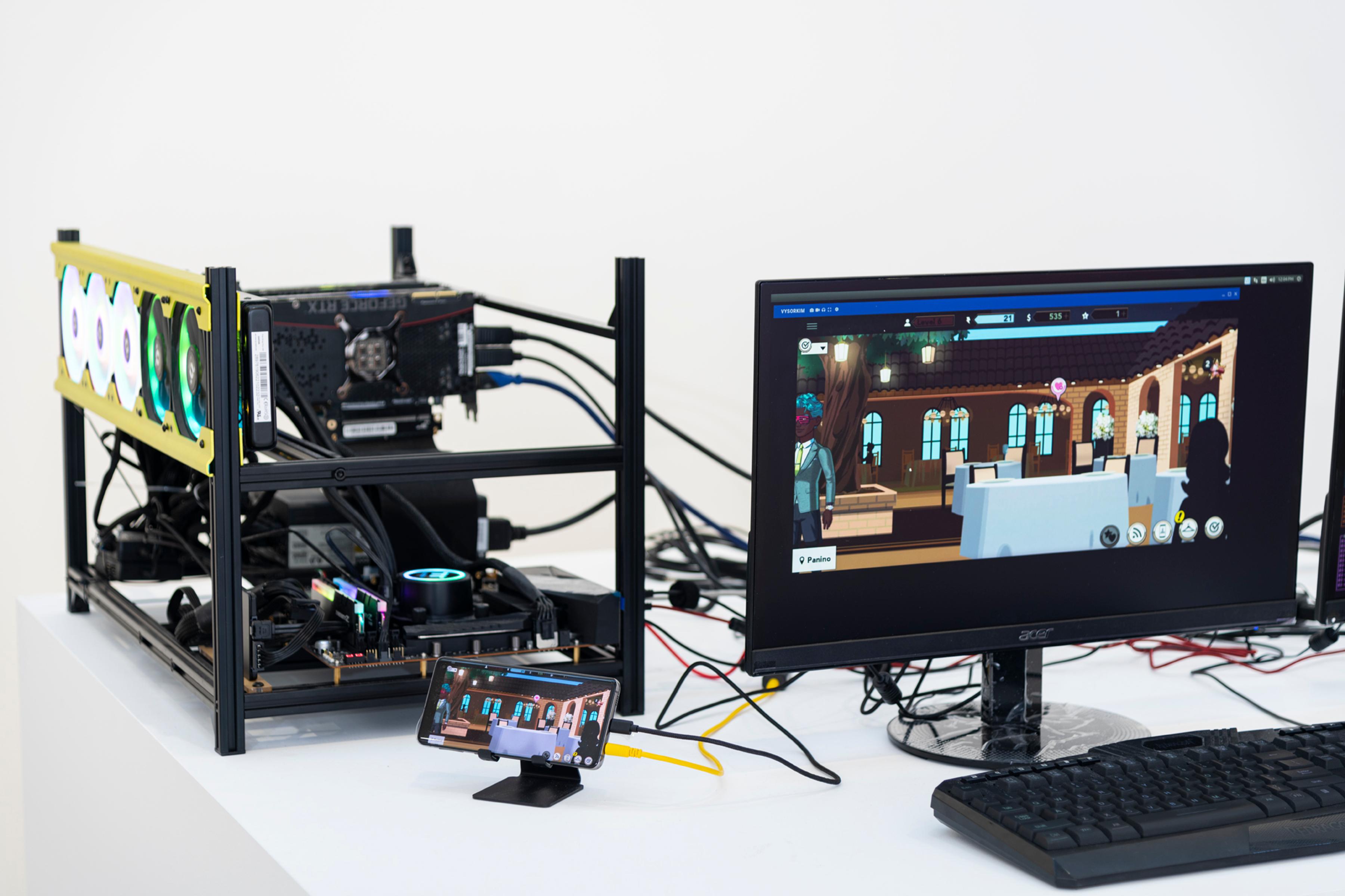
Cory Arcangel. /roʊˈdeɪoʊ/ Let's Play: HOLLYWOOD, 2017-2021. Custom built high performance computer rig (AMD Ryzen 9 5950X 16-core 32-Thread Unlocked Desktop Processor central processing unit, Rog Crosshair Viii Dark Hero motherboard, G.SKILL 64GB (2 x 32GB) Trident Z Neo Series DDR4 PC4-21300 2666 MHz 288-Pin Desktop Memory Model F4-2666C18D-64GTZN random access memory, (x2) EVGA 24G-P5-3975-KR GeForce RTX 3090 XC3 Ultra Gaming graphics processing units' & Corsair Professional Series AX 1200 Watt Digital ATX/EPS Modular 80 PLUS Platinum (AX1200i) power supply, various peripherals), custom built Deep-Q Learning RPG playing software bot with system sounds by Daniel Lopatin (Oneohtrix Point Never), Kim Kardashian: Hollywood casual free-to-play role-playing Android game, Android phone, amplifier & speakers, various cables. (Installation view: Century 21, Greene Naftali Gallery, New York, USA, March, 2021 - April, 2021) Photo: Zeshan Ahmed. Courtesy: the artist, Greene Naftali.
What kind of withdrawal is this? They associate Arcangel’s withdrawal from expression with the attitude of Herman Melville’s fictional antihero in the short story “Bartleby, the Scrivener” (1853). When asked by his superior to execute a task, Bartleby always answers, “I would prefer not to.” His withdrawal from carrying out orders is interpreted by Galloway and LaRivière as a “productive unworking,” “a positive tactic.”Galloway and LaRivière, “Compression in Philosophy”: 127. They compare his strategy to the “No demands!” strategy of the global Occupy movement.Judith Butler (“For and Against Precarity,” Tidal: Occupy Theory, Occupy Strategy, no. 1 (December 2011): 12–13, https://monoskop.org/images/8/81/Tidal_Occupy_Theory_Occupy_Strategy_1_2011.pdf.) explains: “The reason it is said that sometimes there are ‘no demands’ when bodies assemble under the rubric of ‘Occupy Wall Street’ is that any list of demands would not exhaust the ideal of justice that is being demanded.” From the command-and-control imperative of state bureaucracy, Big Tech platforms, and commodity capitalism, Bartleby’s response, like Arcangel’s one thousand minor machines, appear dysfunctional. Their opacity leaves no clear identity markers for the system. However, their attitude also “reveals the basic insufficiency and indistinction of the real phenomena of everyday life.”Galloway and LaRivière, “Compression in Philosophy”: 127–128. The media of big corporations want everybody to “express themselves” through processes of sharing and liking, but the expressive affordances they offer only allows for an extremely limited and reduced version of life to be expressed, unable to capture what living is like for most people.
As capitalism is extremely adept at subsuming nearly all criticisms of its machinations into the logic of capital itself, “what remains irrecuperable is the ‘absolute indifference’ of unemployed negativity,” write Galloway and LaRivière.Galloway and LaRivière, “Compression in Philosophy”: 136. Bartleby’s and Arcangel’s micropolitical withdrawal implicitly unworks or challenges systems of power not through direct opposition but by stepping outside the rules of engagement. Their resistance is a tactical response in need of interpretation. Galloway and LaRivière rely on philosopher Giorgio Agamben’s reading of Bartleby. “Bartleby’s opaque indifference to work and his refusal to order the real make him an ideal model for withdrawal from the representational contract. Through a kind of productive unworking, Bartleby gestures toward new forms of life and revitalized potentials for living in community,” Agamben writes.G. Agamben, The Coming Community (University of Minnesota Press, 1993), 44. To him, withdrawal and unworking may imply a new beginning, the “potentiality” to become something new, and to claim “impotentiality” with regards to a working system that tries to control and benefit from the work of its members.Agamben elaborates on potentiality in this way: “What appears for the first time as such in deactivation (in the Brachliegen) of possibility, then, is the very origin of potentiality—and with it, of Dasein, that is, the being which exists in the form of potentiality-for-being [poter-essere]”; from G. Agamben, The Open: Man and Animal (Stanford University Press, 2004), 67. Italics in original.
Bartleby’s and Arcangel’s micropolitical withdrawal implicitly unworks or challenges systems of power not through direct opposition but by stepping outside the rules of engagement. Their resistance is a tactical response in need of interpretation.
Arcangel’s “simply leaving be,” inherited from Bartleby, erects “inexpressible” machines, disconnected and stupid. They turn the striated spaces of cybernetic capitalism into a folly. He consistently redirects the flows of industrial media into the dysfunctional and unplayable (computer games), the useless (as in his search engine Dooogle), the crash (Permanent Vacation), a reassembled collectivity (Paganini Caprice No. 5 and Working on My Novel), and the uncanny (Century 21). The works are not just relics but decomposed matter, a vast fallow land where potential resides in its impotentiality. The withdrawal of expression throws sand in the gears of the cybernetic machine.
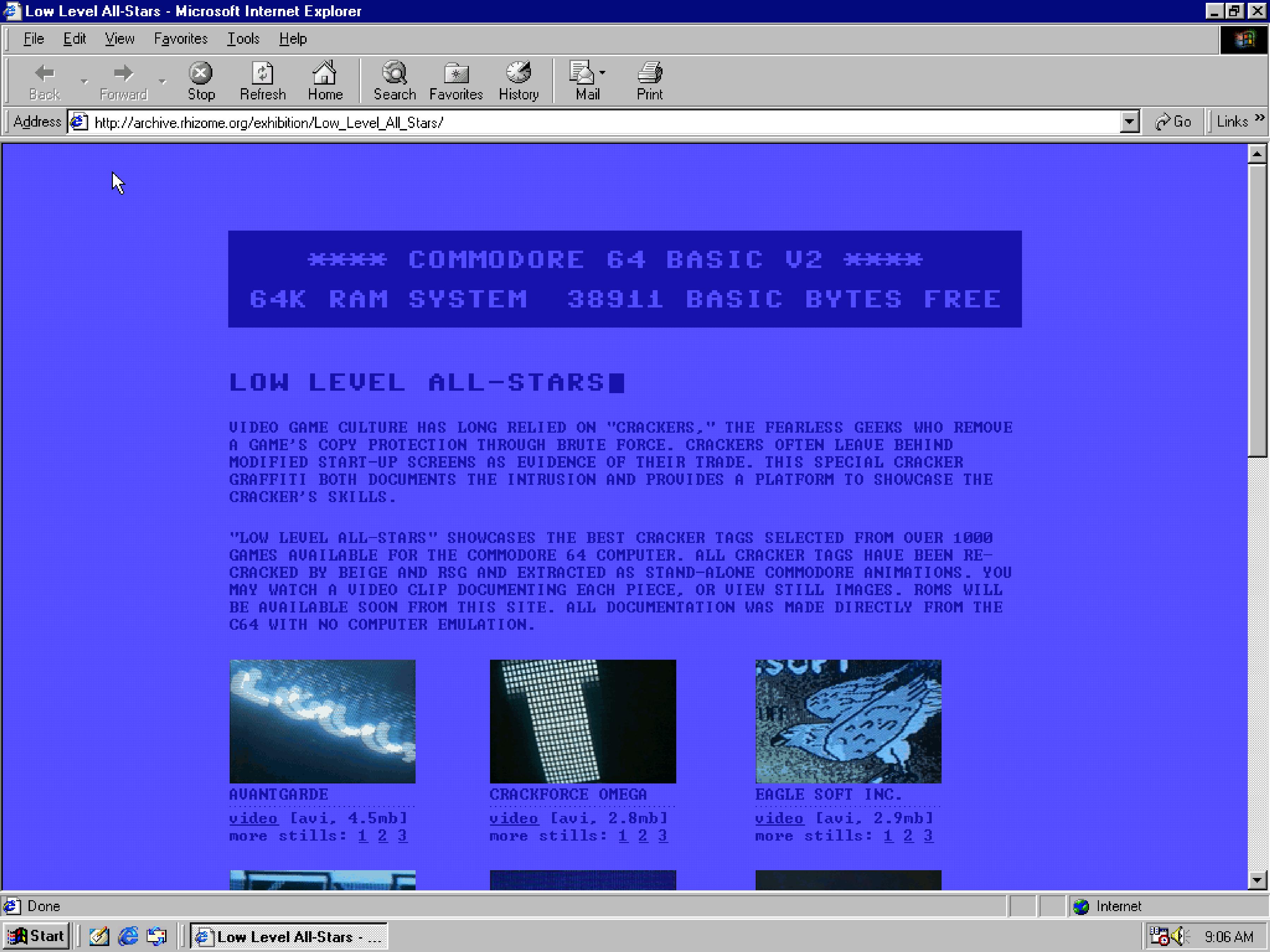
Cory Arcangel and Alex Galloway (under the auspices of Beige + RSG). Low Level All Stars. Website exhibition. Photo: Cory Arcangel. Courtesy: the artists. Historically accurate screen shot created using oldweb.today.
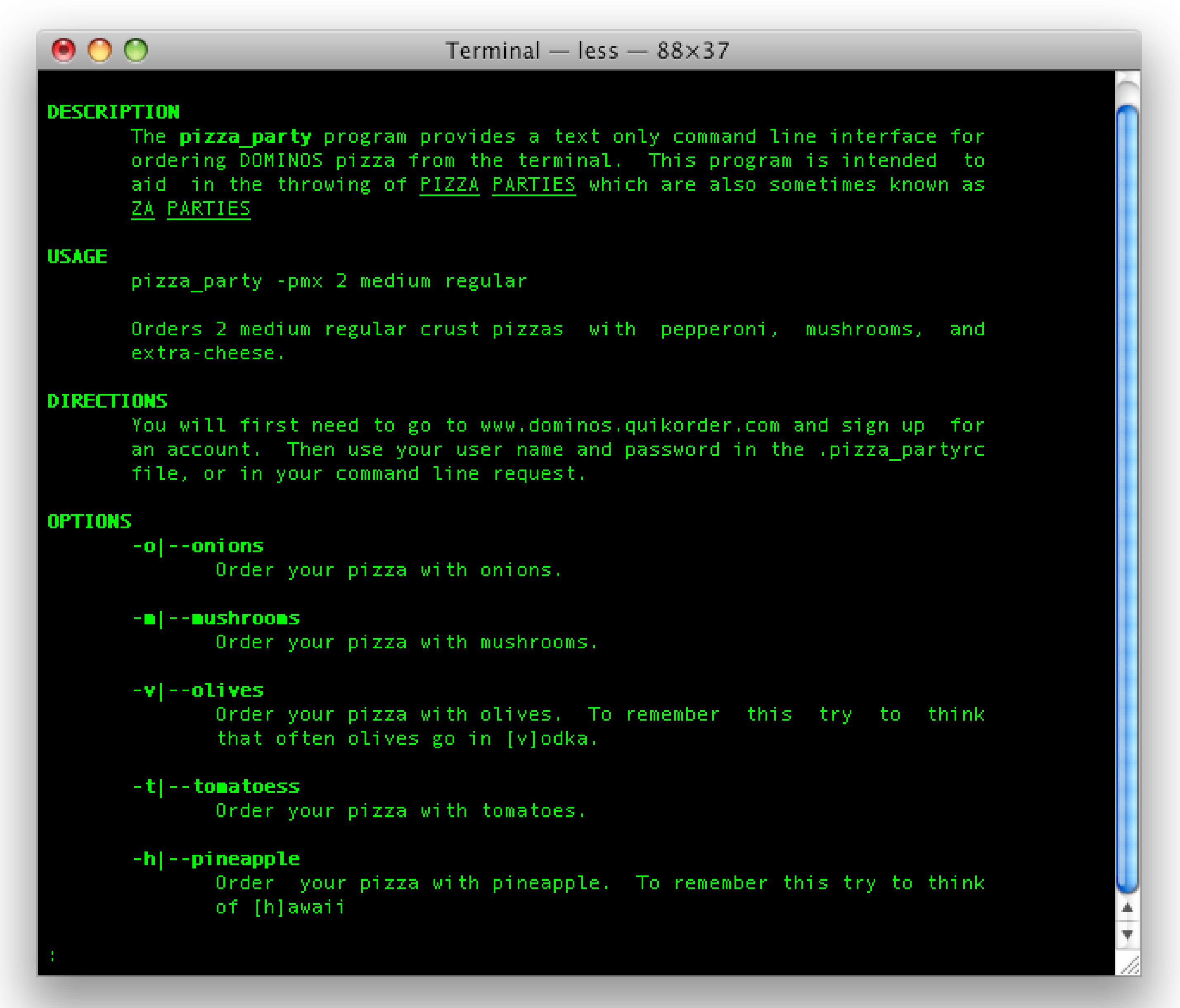
Cory Arcangel & Michael Frumin. Pizza Party, 2004. Software. Photo: Cory Arcangel. Courtesy: the artists.
A Thousand Minor Ecologies
Perhaps Arcangel’s “dysfunctional” machines are reserves put on hold, awaiting an alternative sociality to come? A withdrawal of one type of expression is also an affirmative opening toward another; it can “take anything and make it into a matter of expression.”G. Deleuze and F. Guattari, Mille Plateaux: Capitalisme et schizophrénie 2 (Les Éditions de Minuit, 1980), 316. I paraphrase Deleuze and Guattari’s vitalist approach to intervention from A Thousand Plateaus. Any withdrawal, any unworking, produces a matter of expression. Typically, it can invert qualities, make content a form or form a content, as the Cory Arcangel hack does in the schiz-image. Deleuze and Guattari explore this in relation to how interventions create a new milieu in a territory, where “expressive qualities or matters of expression enter into shifting relations with one another that ‘express’ the relation of the territory they draw to the interior milieu of impulses and exterior milieu of circumstances.”Deleuze and Guattari, Mille Plateaux, 317. The intervention produces new movements in the world that builds a territory through hacks. The hacks are like “refrains” or building blocks that deterritorialize to build a new territory. Arcangel’s aesthetics of breakthroughs and schizzes highlight the possibility of a techno-aesthetic heterogenesis where an unknown agency or matter-function begins to speak, to gather, to fathom.
The Cory Arcangel hack tampers with the flow-paths of electricity, not only in games and social media but in the playing subject itself and its relation to agency and change. It can replace an action- and goal-oriented instrumental attention that only wants to beat the game with a new social ontology, an open collective of modified agents which, in their nonstandard use, can be “object-comrades or coworkers of an emergent social order of human–thing relationality.”I. Blom, The Autobiography of Video: The Life and Times of a Memory Technology (Sternberg Press, 2016), 28. The hack shows what a host of tools and micromedia—microchips, EPROMs, ROM hacks, RAM hacks, API hacks, the Android Debug Bridge, Gould Pro tools, monkeyrunner tools, a TIVO-tool, coding, mods, platform hacks, stuttering affordances and feeds, and wild bots—can do. They introduce a swarm of reticular middles, changing our notions of mediation and bifurcation, and create so many “infuriation events,” producing a new collectivity, a sociality, acephalous and energetic.On “the infuriation event” of new media, see A. Galloway, “What You See Is What You Get?” in The Archive in Motion: New Conceptions of the Archive in Contemporary Thought and New Media Practices, ed. E. Røssaak (Novus Press, 2010), 163. These are social inventions teaching us to reassemble and think the social in new ways.
Here’s how I do it; here’s my code: spread the word, change the subjects.
This networking practice lays the foundation for new experiments and
alternatives, new models of thought and imagination and, not the least,
for a swarm of new hacks.
Allied to the hacker ethic of sharing, Arcangel explores flow-cut arrangements that can open new and potentially collective flow-paths. Here’s how I do it; here’s my code: spread the word, change the subjects. This networking practice lays the foundation for new experiments and alternatives, new models of thought and imagination and, not the least, for a swarm of new hacks. The sharing of codes is both based on and creates a community of hackers, do-it-yourself carpenters, and artists. His hacks gain a potential life in other networks and on other premises outside the art world. The sharing culture of hackers is a countercultural gift economy in which gifts are shared in a “coming community,” according to Wark’s A Hacker Manifesto.M. Wark, A Hacker Manifesto (Harvard University Press, 2004), paragraphs 274 (on the coming community) and 203 (on the gift economy). Arcangel’s new flow-cut arrangements introduce new movements, sensations, and collectives, transcending the homogenizing effects of platform capitalism. A thousand minor ecologies multiply through a politics of distribution and sharing—and critique.E. Hörl, “A Thousand Ecologies: The Process of Cyberneticization and General Ecology,” in The Whole Earth: California and the Disappearance of the Outside, ed. D. Diederichsen and A. Franke (Sternberg Press, 2013), 130.
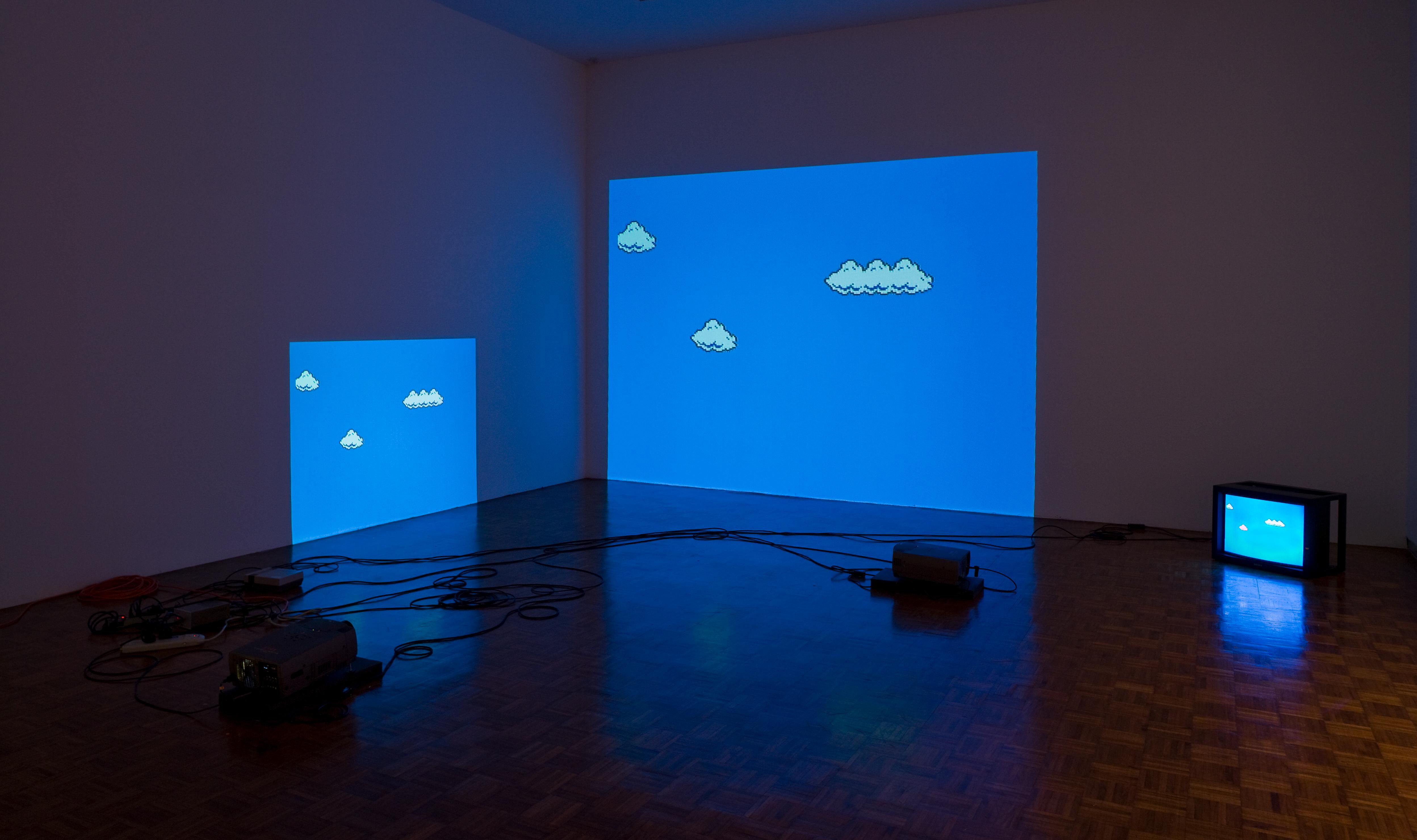
Cory Arcangel, Super Mario Clouds, 2002 (installation view, Synthetic, Whitney Museum of American Art, New York, January 22-April 19, 2009). Handmade hacked Super Mario Brothers cartridge and Nintendo NES video game system. Whitney Museum of American Art, New York; purchase with funds from the Painting and Sculpture Committee 2005.10. Photograph by Sheldan C. Collins.
His attention to the fact that the technology around us can be reprogrammed has urgency in an age where the protected mode of computer systems “guards the operating system from users.”F. A. Kittler, The Truth of the Technological World: Essays on the Genealogy of Presence, trans. E. Butler (Stanford University Press, 2014), 212. We do not program anymore, we are programmed. Protected mode and black-boxed systems become habitual new media. “It is through habits that users become like their machines,” claims media researcher Wendy Hui Kyong Chun.W. H. K. Chun, Updating to Remain the Same: Habitual New Media (MIT Press, 2016), 1. The naturalization of media as something unprogrammable is a makebelieve trap that can be circumvented through programming skills, can be changed, defunctionalized, short-circuited, and refunctionalized. The Cory Arcangel hack cracks the image of the “perfect” human/machine connection and suspends or interrupts the immediate sensorimotor stimuli that locks the subject into a given flow-path. The deferral of action bifurcates the subject and puts it into a mode seeking out different actions challenging the narrow, efficiency-driven perspective of Big Tech. This can foster a more collective and collaborative rethinking of shared resources, spaces, and experiences. By cutting into and repurposing flows, the hack points to other arrangements beyond the docility of instrumentarian utilitarianism. Such reworkings of the commons could involve reimagining how we share and manage resources, how we build and sustain communities, and how we resist commodification and enclosure by focusing on collective and creative engagement.
The hack, however minute, can enact a necessary alchemy—like homeopathy, altering a path just enough.
The Cory Arcangel hack is an attempt at creating sites for thinking about and making alternative becomings. Critics and curators Tim Griffin and Lumi Tan write that Arcangel’s radical do-it-yourself mix of old and new technologies “allows for an escape from and a distance to the totalizing and normalizing forces of any technological regime.”T. Griffin and L. Tan, “After the Fact,” in Cory Arcangel & Olia Lialina: Asymmetrical Response, ed. C. Jones (Walther Koenig Books, 2018), 53. The hack, however minute, can enact a necessary alchemy—like homeopathy, altering a path just enough. Within the vast machinic milieu of cybernetic capitalism, there is always a remainder, an unused matter-function that the hack can leverage. In doing so, it can forge new alliances and connections, bringing forth visibilities and socialities that might otherwise remain unsensed, unseen, or unarticulated.
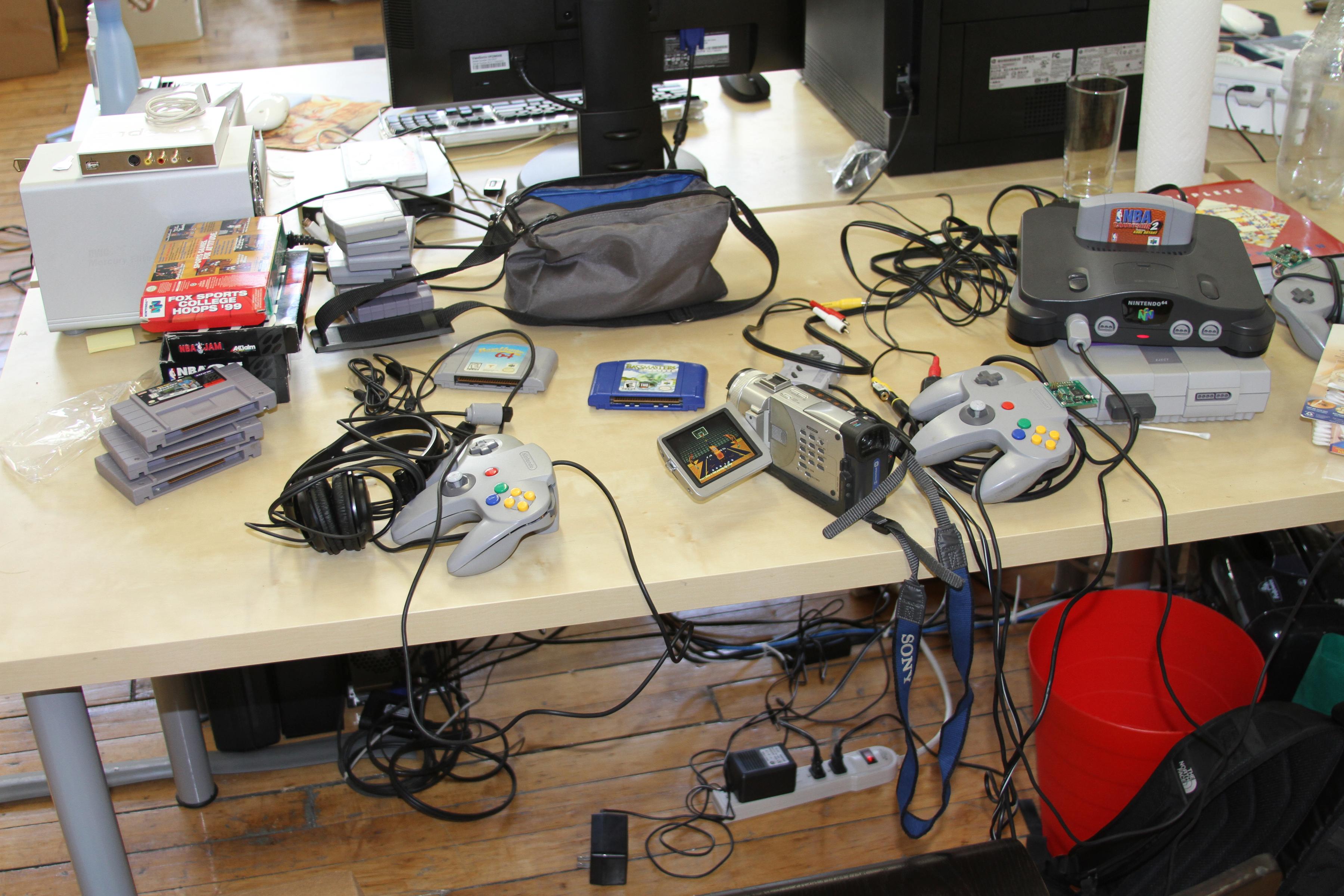
Arcangel’s studio, February 8, 2011, Brooklyn, New York. Photo: Cory Arcangel.
More info
The Cory Arcangel Hack: Digital Culture and Aesthetic Practice (2025)
Written by Eivind Røssaak. Published by The MIT Press.