Exploring the visual art scene of Norway's southwest coast ➜ Since 2015
“Paint us with joy!”
These works are not simply beautiful; they are defiant. Bergen-based critic Carol Stampone traveled to Stavanger for Citra Sasmita’s exhibition Who Stole the Sky, currently on view at Kunsthall Stavanger. Sasmita, who recently received the prestigious Sovereign Asian Art Prize, made Stampone question her consumption of the show, rule-breaking in white cubes, and the nature of Sasmita’s repetitive female figures.
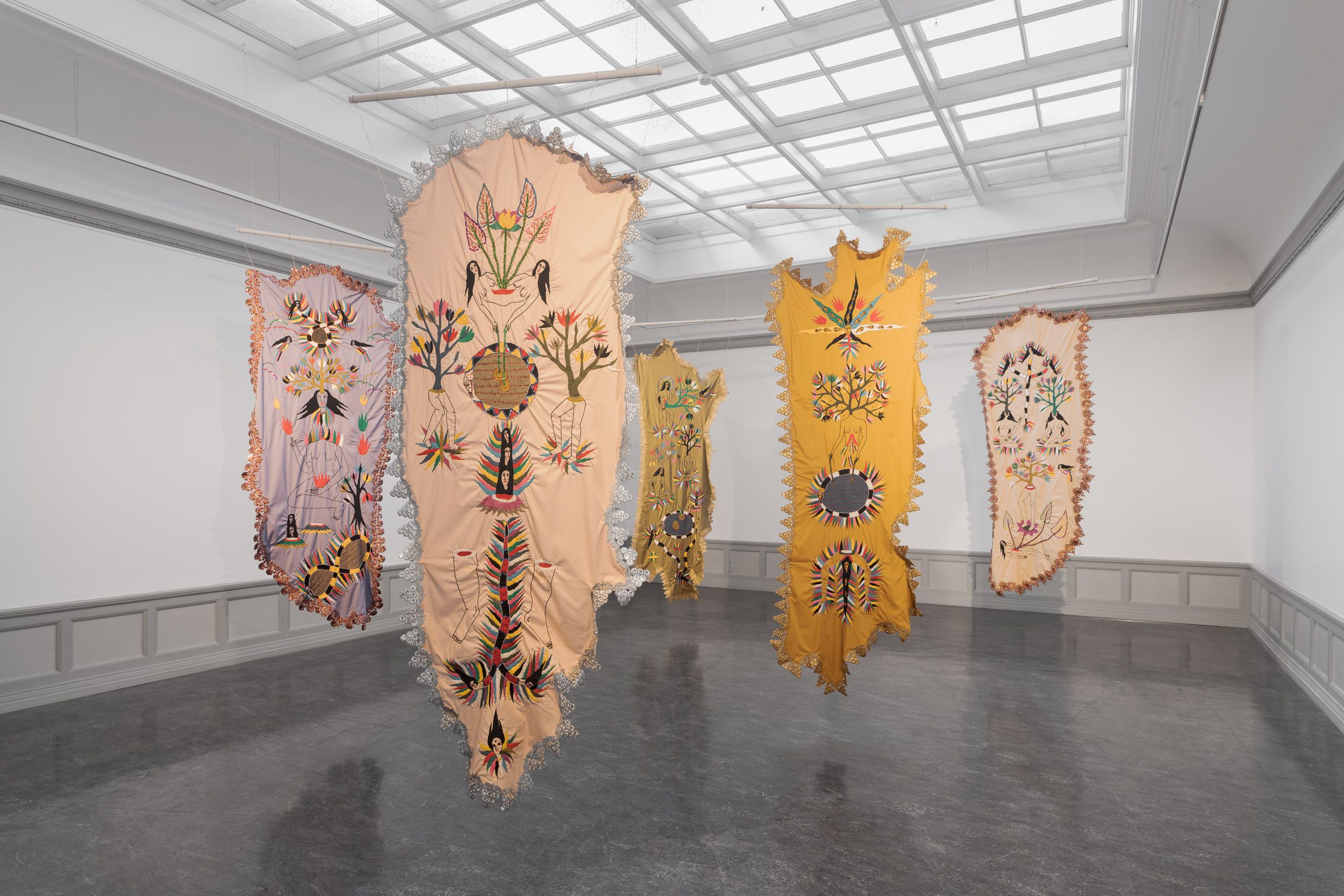
Citra Sasmita, Who Stole the Sky (2026). Image courtesy of Kunsthall Stavanger: Installation view. Photo: Erik Sæter Jørgensen.
When standing inside Citra Sasmita’s exhibition Who Stole the Sky at Kunsthall Stavanger, what touched me most was her sharp demand: “paint us with joy!”. I arrived exhausted, and I confess that at first, I fell into the habit of simply consuming it. Apologies, Citra. I did not mean to. But the obligation to multitask, dressed as freedom, has been killing me. Luckily I was pulled out of consumption-mode by a little girl – we’ll get back to her.
Whose language am I inhabiting? Whose story? Under whose sky is my story unfolding?
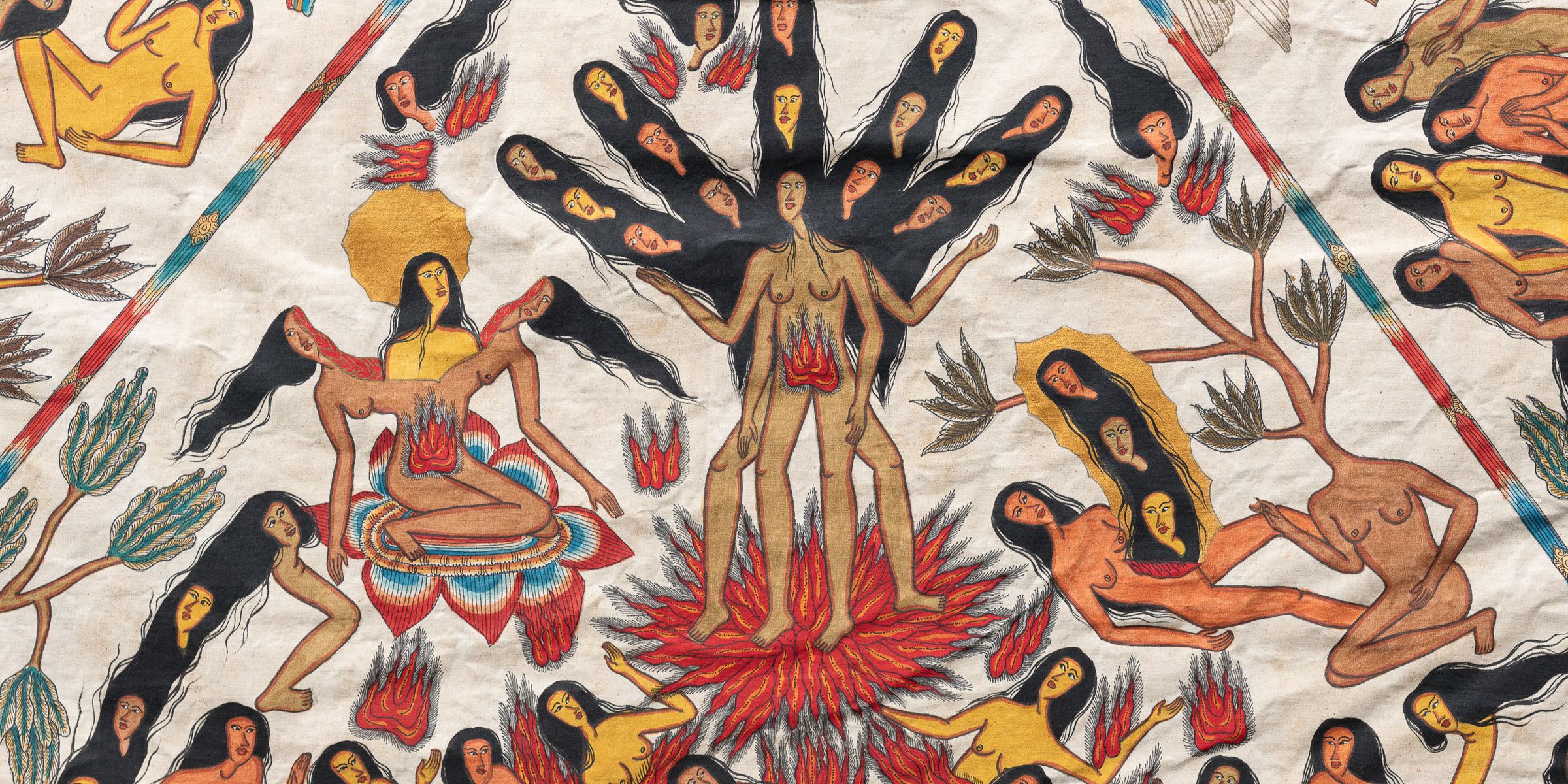
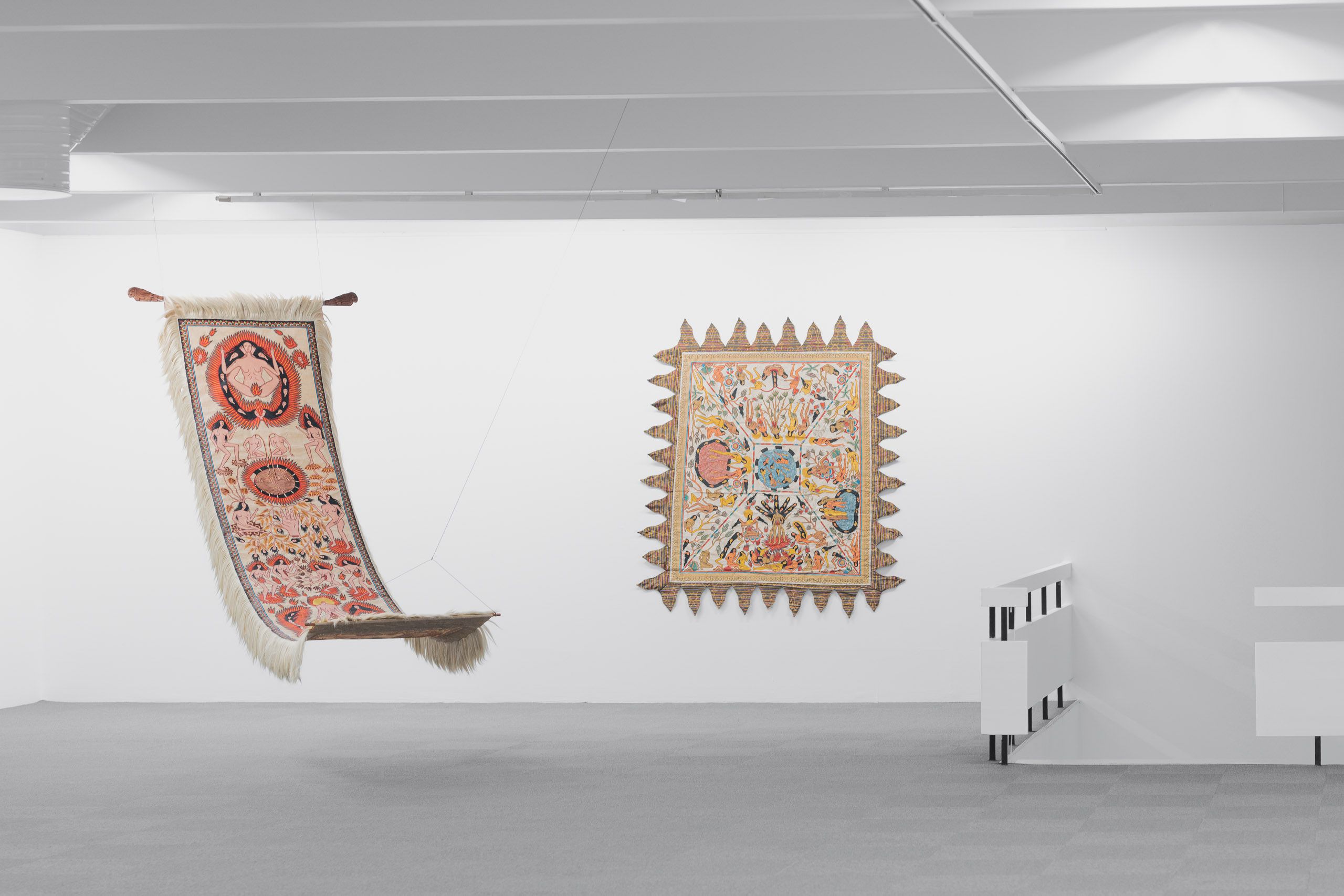
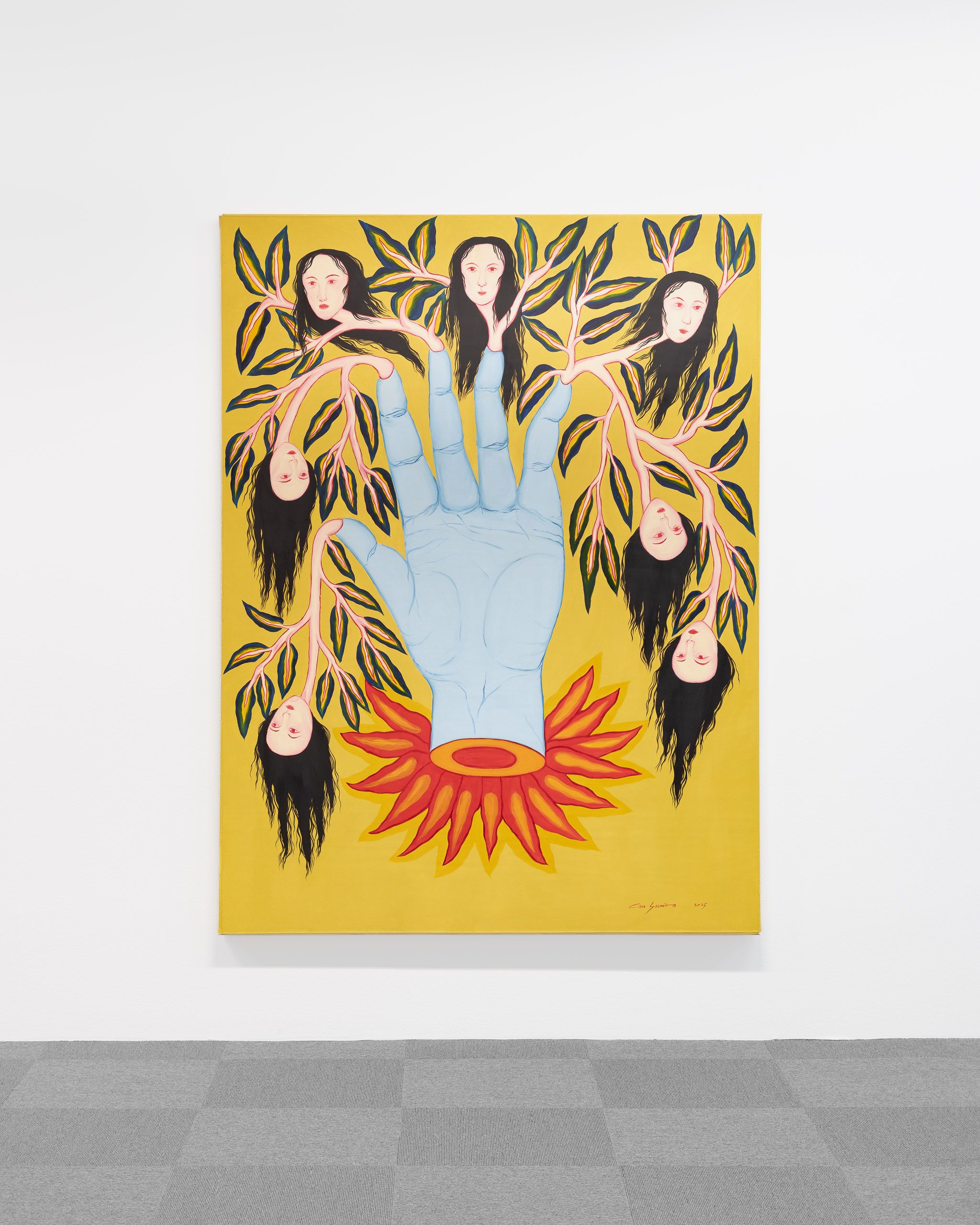
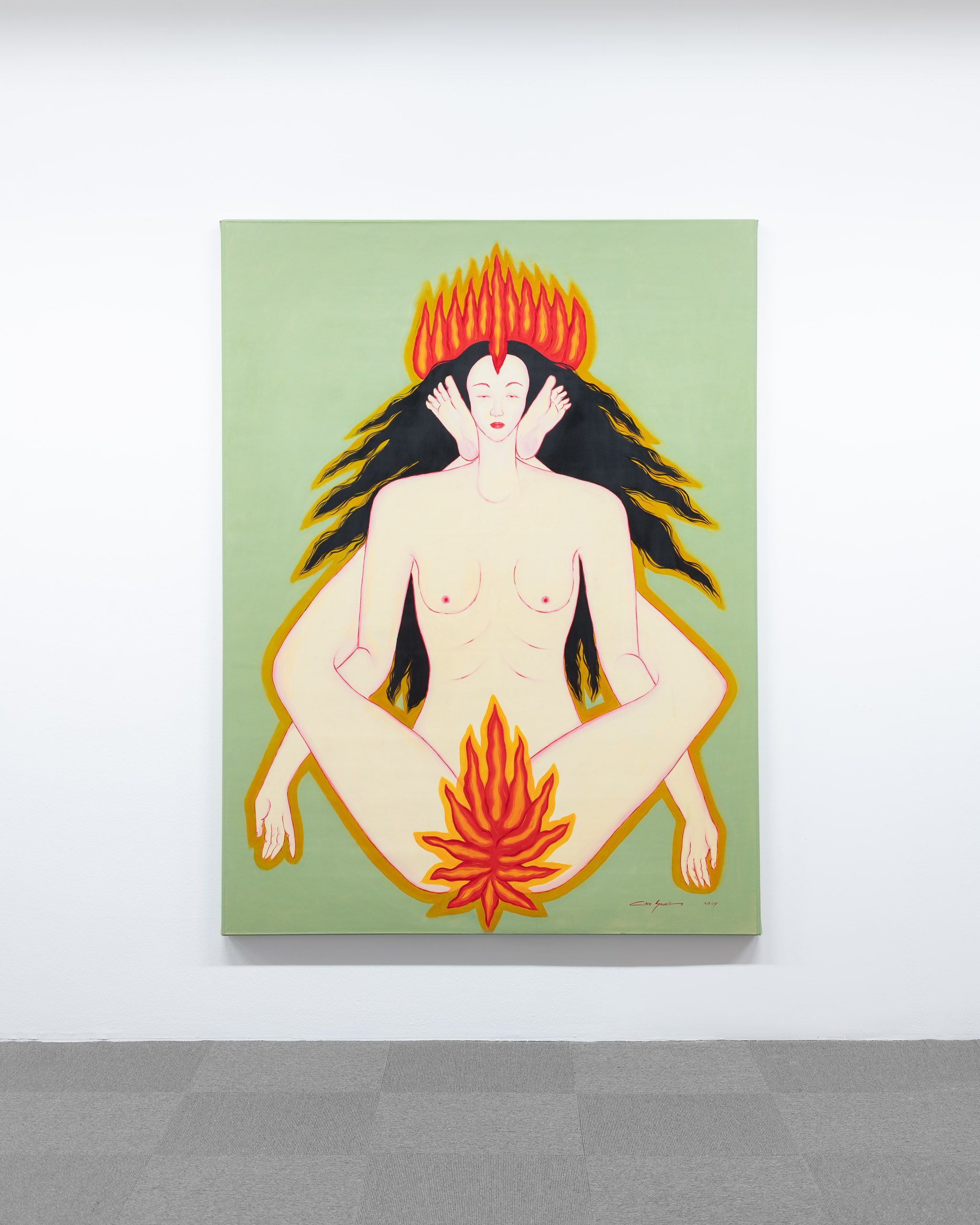
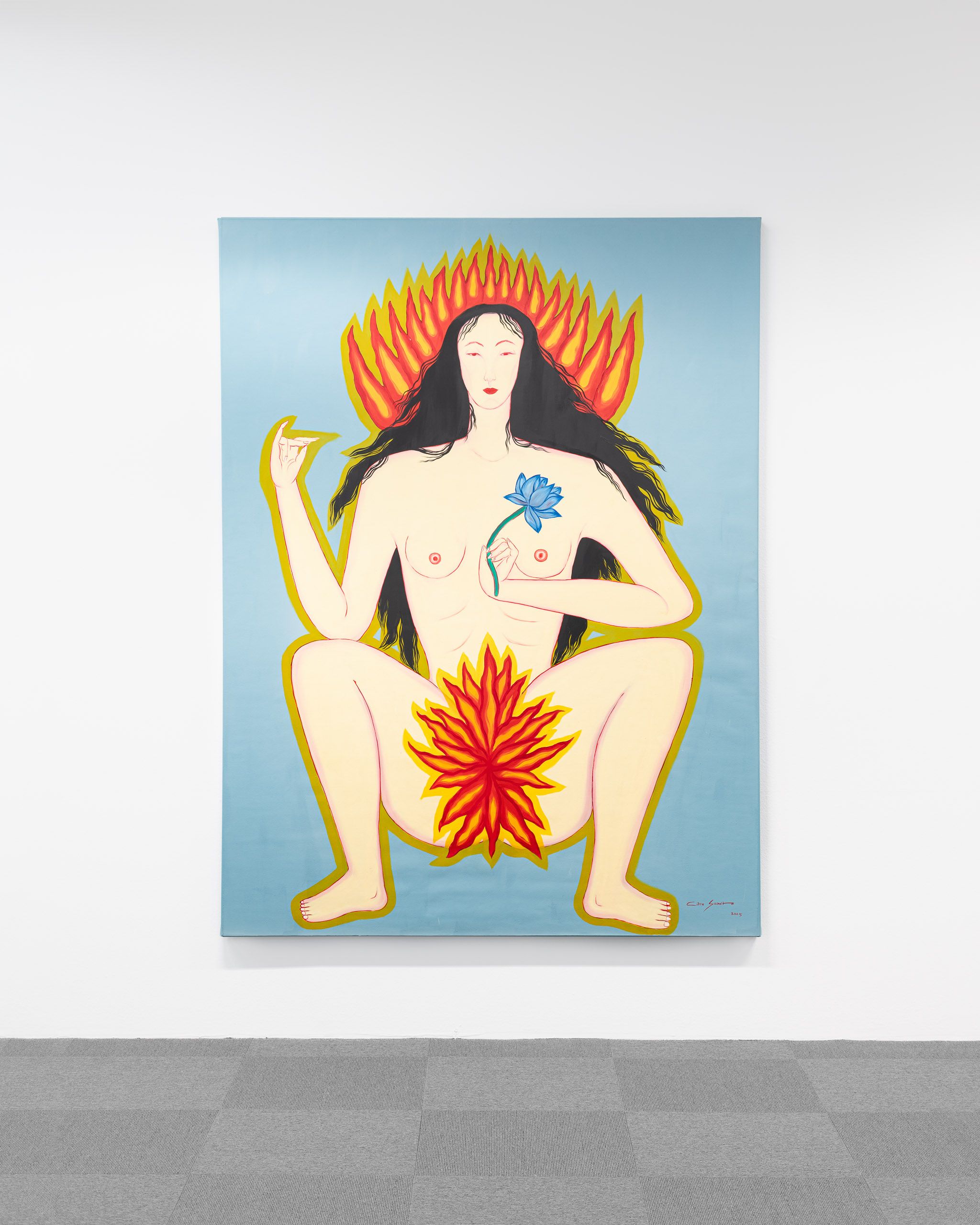
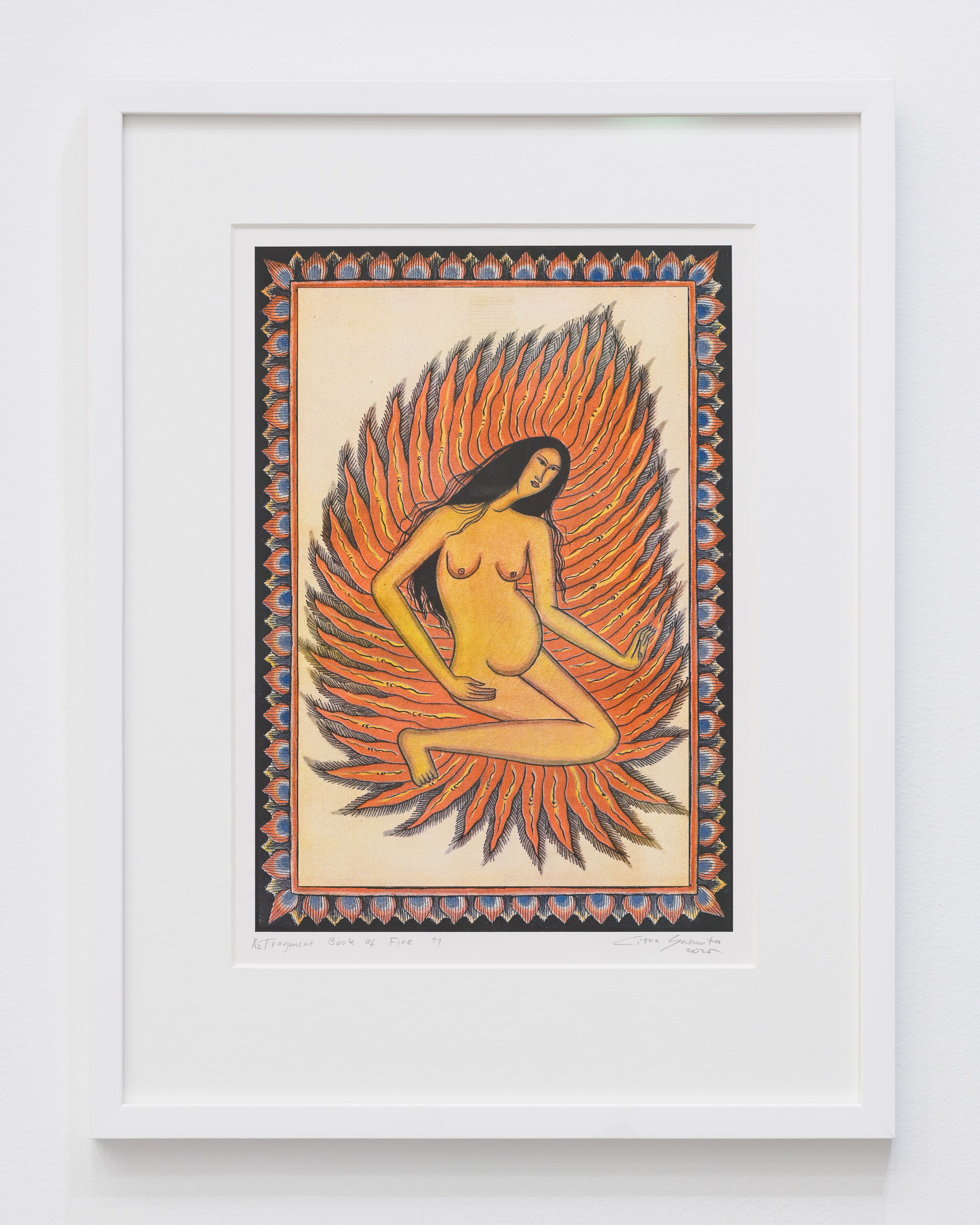
Sasmita’s exhibition consists of twelve works spread across three of the Kunsthall’s galleries. In each work I see a woman; the same woman, again and again and again. The color of her skin changes, as do the backgrounds and materials with which she is depicted. But it is always the same woman, or perhaps all women, and she is always naked. Her nakedness felt like a refusal of the made-up patriarchal freedom that was sold to us. Years ago, The Laugh of the Medusa by the feminist philosopher and writer Helène Cixous dared me to leave my own mark in the world, instead of simply fulfilling the roles assigned to me by others. Here as well, I felt the call to become myself. Sasmita has created an environment where we can breathe, think, and feel – a universe where we can imagine, or perhaps, remember something older and deeper than the stories we have been told. Whose language am I inhabiting? Whose story? Under whose sky is my story unfolding?
Citra Sasmita, Who Stole the Sky (2026). Image courtesy of Kunsthall Stavanger: Installation view. Photo: Erik Sæter Jørgensen.
Citra Sasmita, Who Stole the Sky (2026). Image courtesy of Kunsthall Stavanger: Installation view. Photo: Erik Sæter Jørgensen.
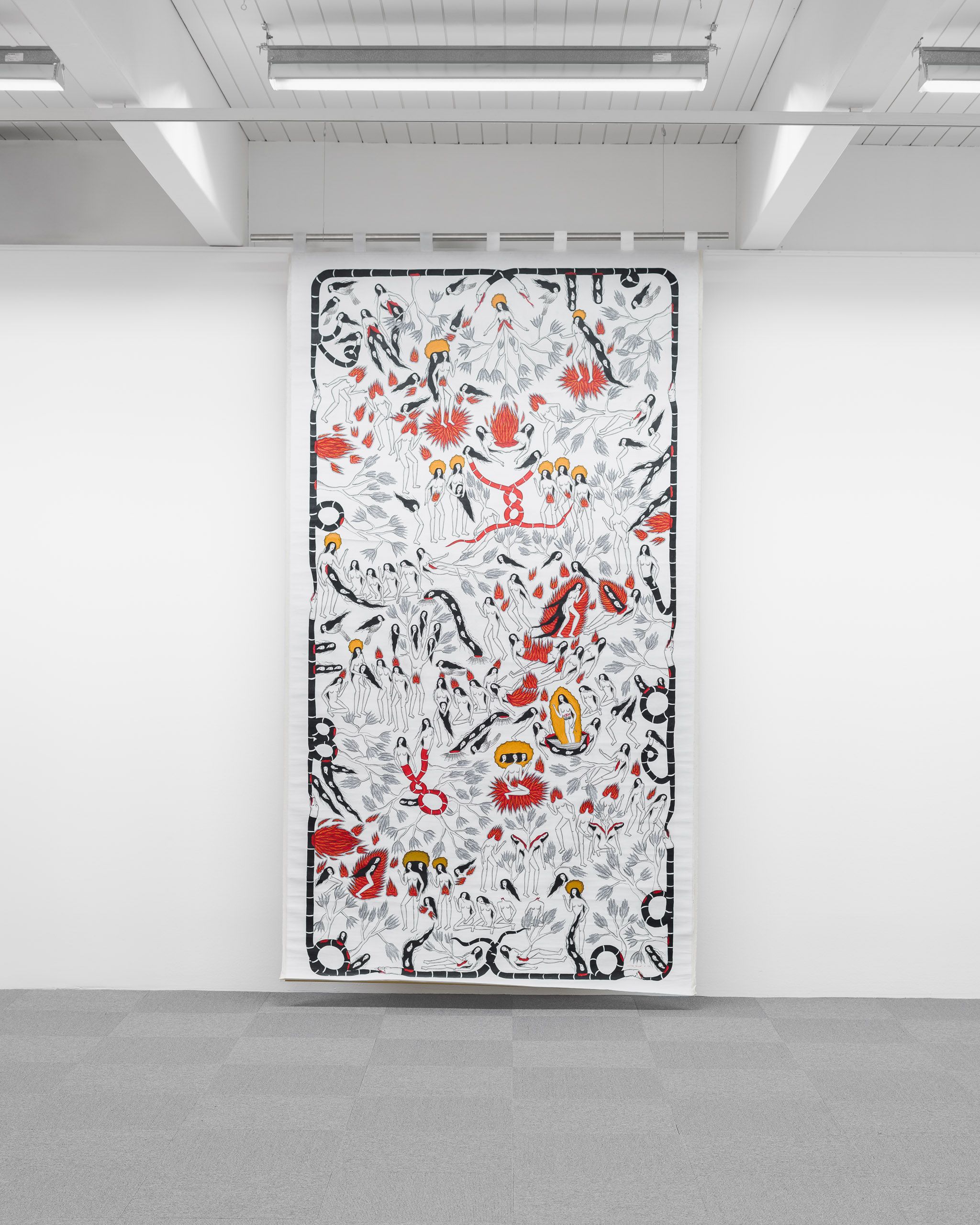
I entered the largest gallery first, where twelve works were displayed. The woman’s face was everywhere, and I immediately felt overwhelmed. I could not escape her. I sensed that she carries a secret that she is willing to share with me, if I get close enough. At the same time, there is a tension as the works are invaded by fragments of what she is trying to resist: small but present references to the Dutch colonialism that fractured the traditional way of life in Bali.
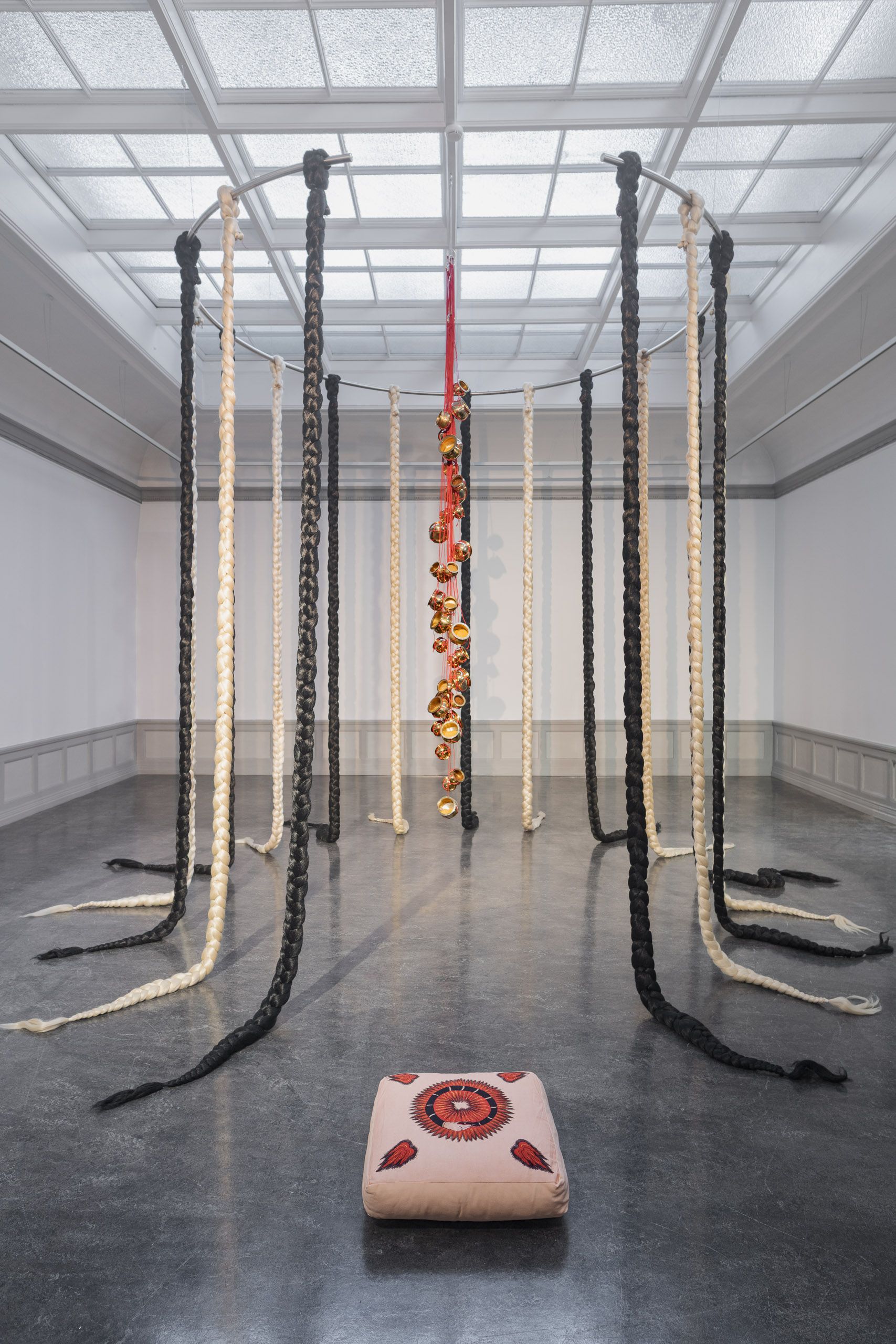
In order to get closer to this woman / these women with long black hair, strong legs, and long arms, I needed to return to myself, somehow exit my hyperactive and exhausted state. I found myself in a small side gallery with the singular installation the Temple of Amygdala (2025). There is an aura of care here shaped by precision, but not perfection.
There is an aura of care here shaped by precision, but not perfection.
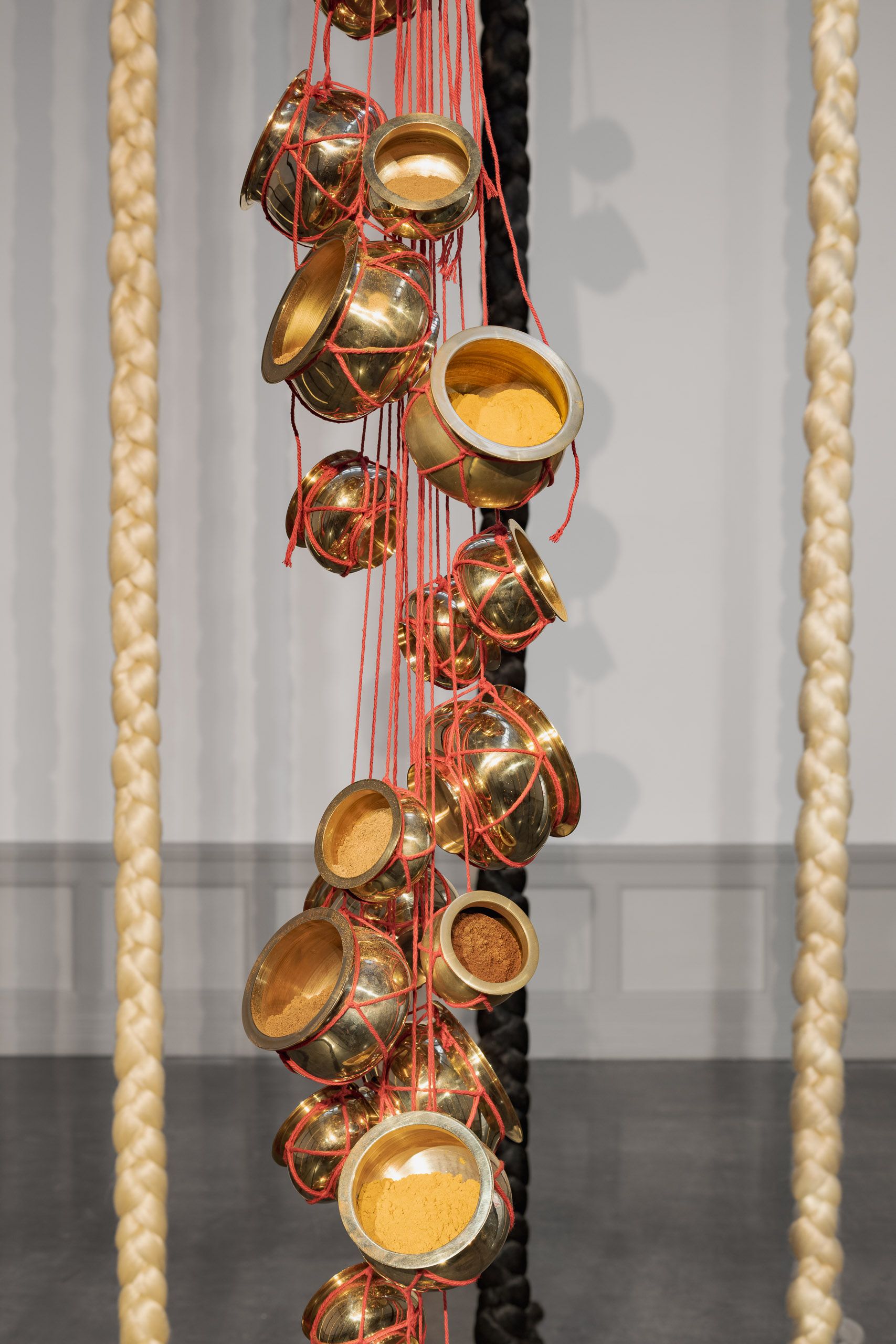
Sixteen long black and white braids of hair hang from a circular metal frame suspended from the ceiling. There is enough space between the braids to enter, but it’s unclear if that is allowed. A collection of golden pots containing an assortment of spices hang by red string in the middle of the ring. While I watched, a little girl ran directly into the center of the “temple” of braids, and gave me the courage to follow. The small, intentional gesture of smelling the spices was grounding, and I was able to temporarily lay aside my never-ending list of obligations. At this moment, I heard a man telling the small girl that she needed to remember the rule. Remember the rule, remember the rule.
Citra Sasmita, Who Stole the Sky (2026). Image courtesy of Kunsthall Stavanger: Installation view. Photo: Erik Sæter Jørgensen.
Citra Sasmita, Who Stole the Sky (2026). Image courtesy of Kunsthall Stavanger: Installation view. Photo: Erik Sæter Jørgensen.
Citra Sasmita, Who Stole the Sky (2026). Image courtesy of Kunsthall Stavanger: Installation view. Photo: Erik Sæter Jørgensen.
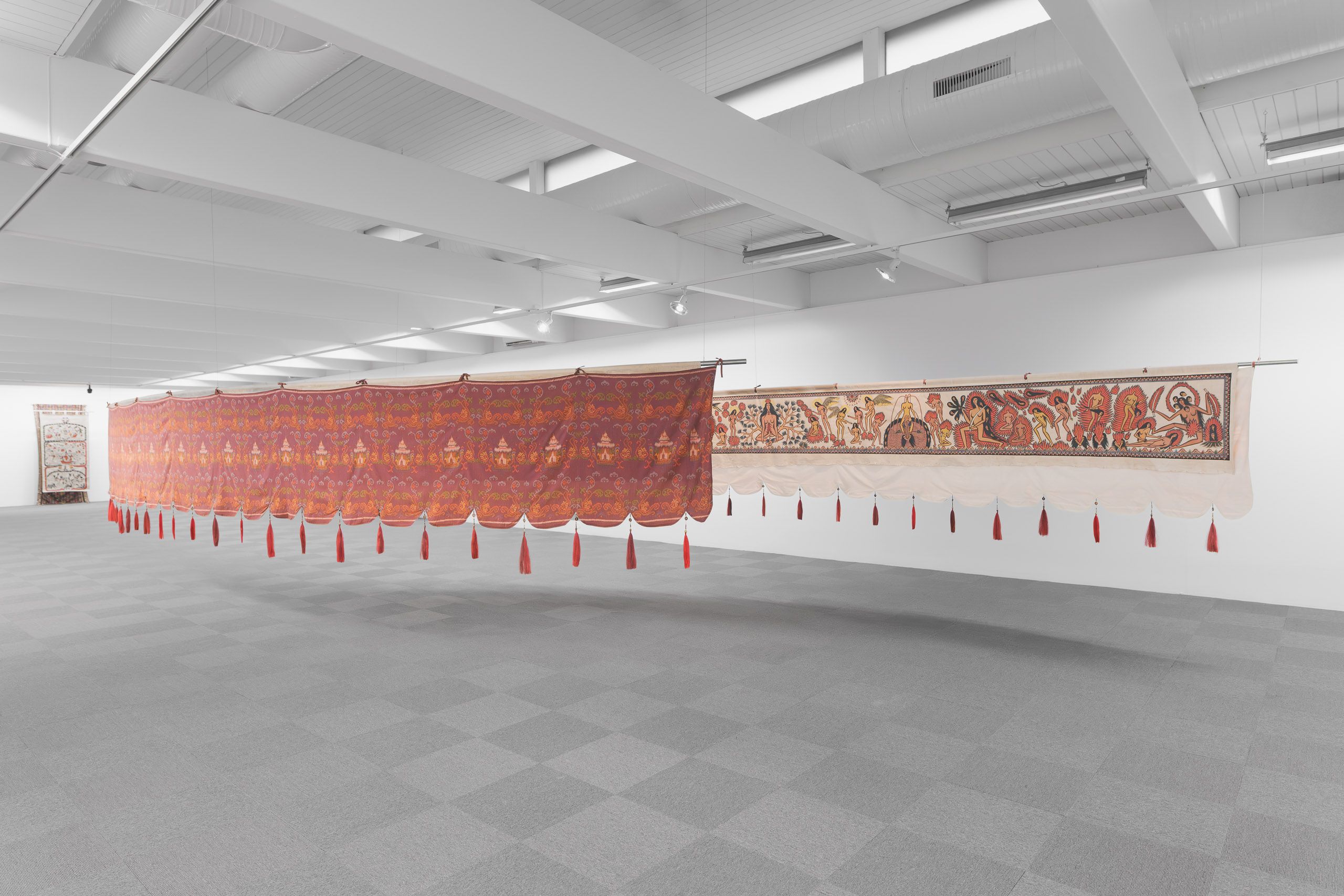
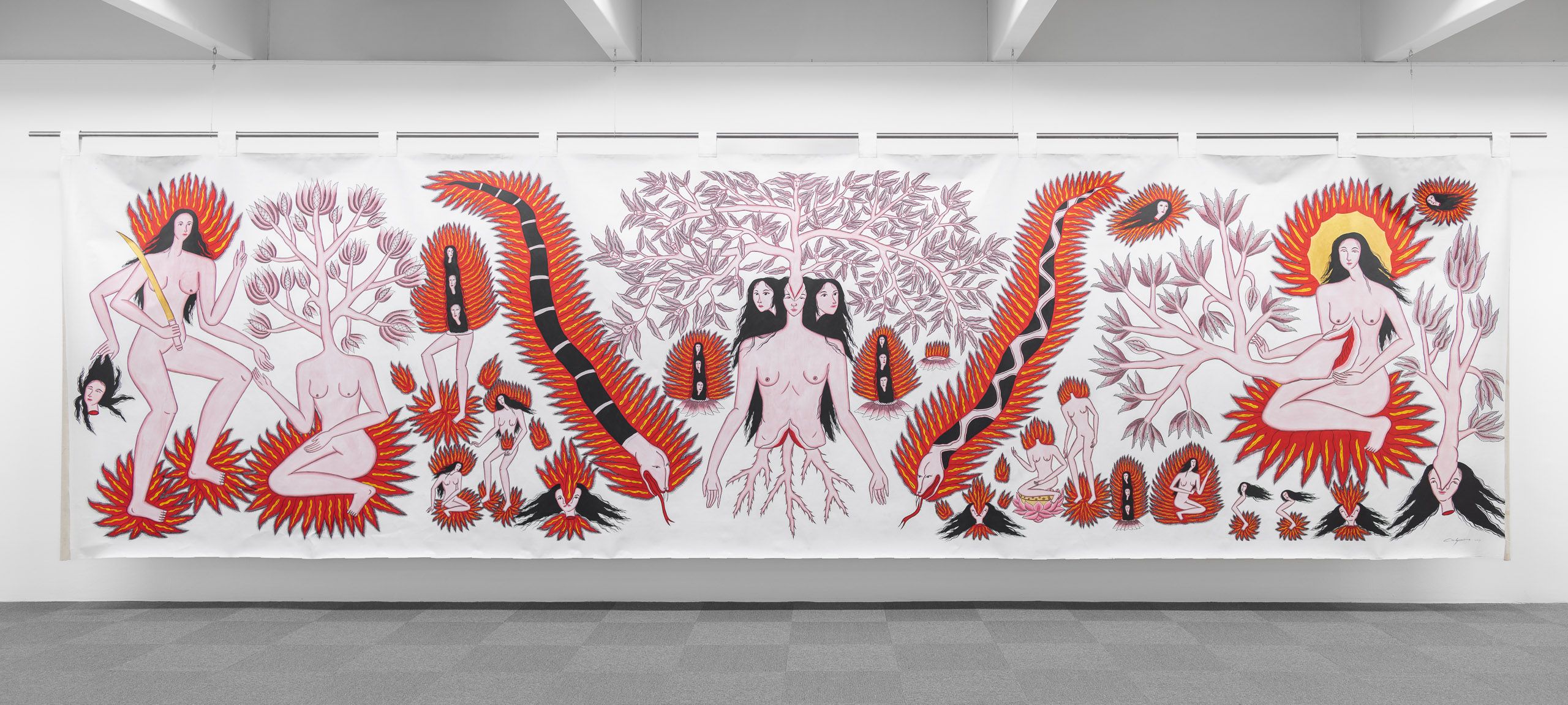
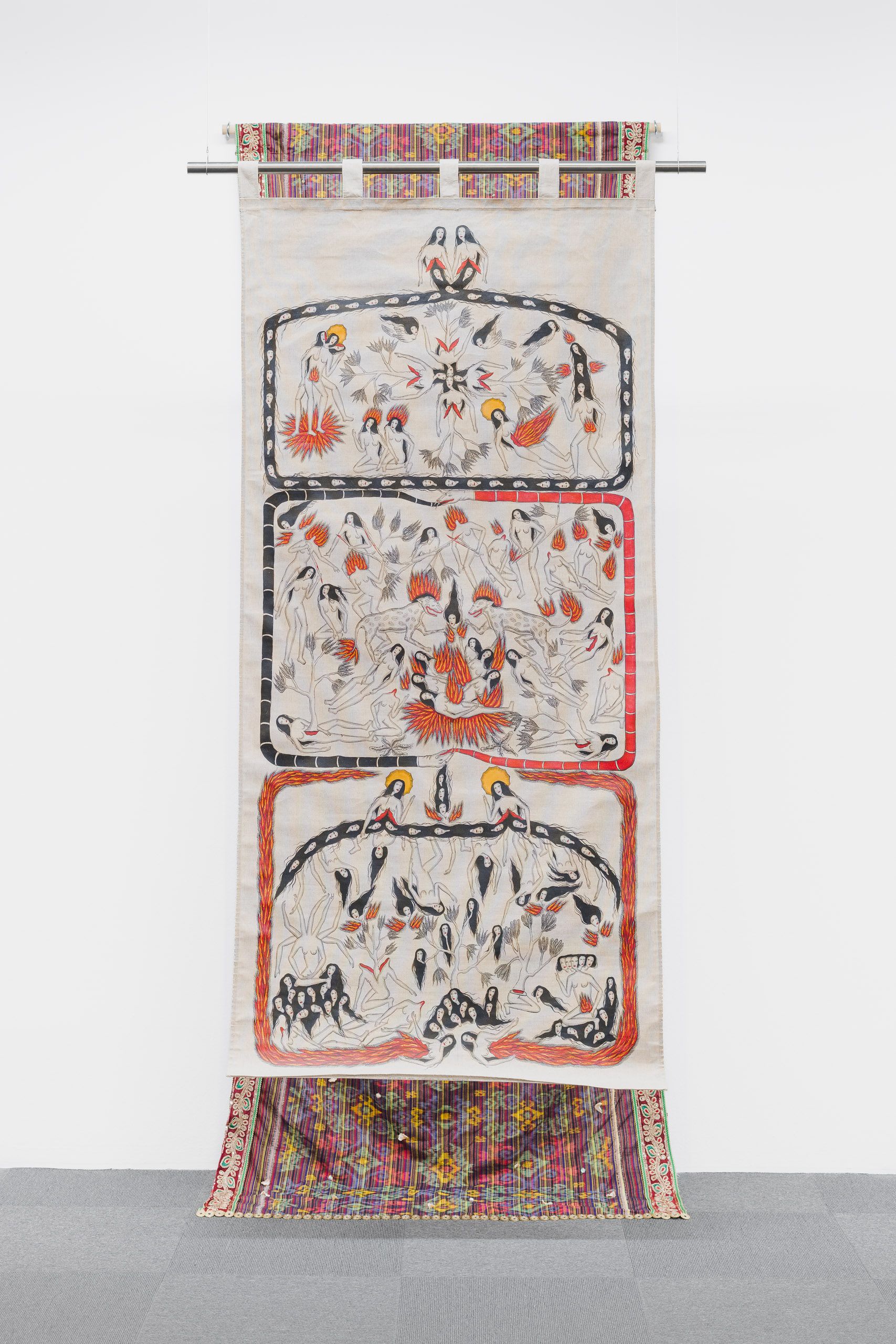
Suddenly, the discomfort I felt in the first gallery made sense. These works are not simply beautiful, they are defiant. The exhibition text states, “the Kunsthall’s main gallery is filled with Kamasan scroll paintings, a tradition historically dominated by heroic patriarchal narratives”. It is not an accident that she returns to a painting tradition from her homeland that has been traditionally reserved for men. Sasmita remembers the rule, and intentionally breaks it. In these works, she acknowledges that we still live in a patriarchal story. She does not refuse the language of patriarchy; instead, she inhabits these stories, rewriting them from the inside out.
She does not refuse the language of patriarchy; instead, she inhabits these stories, rewriting them from the inside out.
Yes, the body of that same woman appears again and again in different forms: holding swords, becoming part snake, or tree, or river. Sometimes the body is split open, and separated from her head(s). In the main gallery, the struggle many of us experience to simply become our true selves is written large. The woman whispers: Slow down, girl. You have the right to slow down. Mom? Is this woman my mother? Yours too?
In Who Stole the Sky, Sasmita replaces the father of the patriarchal story, the one that created and owns everything, with the mother, or as the philosopher and painter Bracha Ettinger puts it in The Matrixial borderspace, a “m-other”.See full book via this link. That is, the first other, the one who is there before any of us becomes a separate self. In Sasmita’s universe, the m-other is imperfect and multiplicitous. She does not possess anyone nor anything, but without her nothing would exist. She is not restricted by a single definition or role. In Sasmita’s depictions of woman, she is a saint, a tree, a snake, a river, a body without a head, a body with many arms, and more. Perhaps she is asking us to pay more attention to what our bodies know...
Citra Sasmita, Who Stole the Sky (2026). Image courtesy of Kunsthall Stavanger: Installation view. Photo: Erik Sæter Jørgensen.
Citra Sasmita, Who Stole the Sky (2026). Image courtesy of Kunsthall Stavanger: Installation view. Photo: Erik Sæter Jørgensen.
Citra Sasmita, Who Stole the Sky (2026). Image courtesy of Kunsthall Stavanger: Installation view. Photo: Erik Sæter Jørgensen.
Citra Sasmita, Who Stole the Sky (2026). Image courtesy of Kunsthall Stavanger: Installation view. Photo: Erik Sæter Jørgensen.
Citra Sasmita, Who Stole the Sky (2026). Image courtesy of Kunsthall Stavanger: Installation view. Photo: Erik Sæter Jørgensen.
Citra Sasmita, Who Stole the Sky (2026). Image courtesy of Kunsthall Stavanger: Installation view. Photo: Erik Sæter Jørgensen.
1 / 6
Who Stole the Sky struck me as a depiction of colonial history as well as an invitation to freedom through the erasure or overwriting of that history with the creation of our own stories, following the ideas of the Afro-Brazilian writer and poet Conceição Evaristo.Evaristo writes about the necessity of black women to ‘borrar’/‘delete’ the past. Memorabilia from Far Away Land (2022) especially attracted and repelled me. It touched an open wound, reminding me of how painful it is to exist in this world under the label “a woman of color”. The work made me question structures of power, access, and once more, whose story I am living within, if not my own.
In a separate gallery, five hand-embroidered textiles titled The Beginning of the Flesh (2025) hang from the ceiling, suspended by wooden rods. There was a gentleness in this space, each textile imperfect but created with care and placed with intention. Contrary to standard exhibition practice, the backs of the embroideries were easily visible, as if to say that the final work should not be separated from the process that gave life to it. I allowed my eyes to dance from one stitch to the next, while thinking of the words by Anne Duffourmantelle: “gentleness is a return to the self that invents the future in the image of the spiral. An open revolution”.
The work made me question structures of power, access, and once more, whose story I am living within, if not my own.
For me, Sasmita’s Who Stole the Sky is an aesthetic embodiment of a practice that is searching for this same spiral. It is a return to the past, a return to the self, a return to the m-other, a return that revives a woman’s desire to belong to the world. It is indeed an invitation for us to write ourselves, and a demand that we be painted with joy. The exhibition is a humble reminder that “our wombs are the universe that births all living things upon the world” – a statement that is visible in each image, but does not demand that the world becomes ours. Instead, it prays that we too remember our place under the sky. Who Stole the Sky itself stands as a ritual, carried by Sasmita from Bali to Norway in the hope of encountering others who too want to become more human together. Thank you Citra, for this invitation.
Citra Sasmita, Who Stole the Sky (2026). Image courtesy of Kunsthall Stavanger: Installation view. Photo: Erik Sæter Jørgensen.
More info
Citra Sasmita: Who Stole the Sky
Kunsthall Stavanger
12 March – 16 August 2026
Disclaimer: CAS International Editor Heather Jones is the co-curator of this exhibition. She has proof read the review, but was not involved in the editing of the text.
About the author
Carol Stampone from the inland state of Minas Gerais, Brazil, and is currently based in Bergen. She is a writer, performer and philosopher, but equally a mother, foreigner and a woman of colour. Stampone has a Bachelor's in Philosophy from UNICAMP in Brazil, a Master's in Philosophy from University of Bergen, theatre training from TEUC in Coimbra, Portugal, and a Master in Fine Arts from Fakultet for kunst, musikk og design, University of Bergen.