Exploring the visual arts scene of Norway’s southwest coast ➜ Since 2015

Art Critic on the Clock

Lori Waxman comes to Stavanger with her work 60 wrd/min, where the performative writing concise art critiques takes center stage. Her critiques of local artists, written over 25 minutes, are hosted by Stavanger kunstmuseum and Sølvberget, and will be published in Stavanger Aftenblad. CAS' International Editor Heather Jones touched base with Waxman on the origins, intentions and logistics of the project.

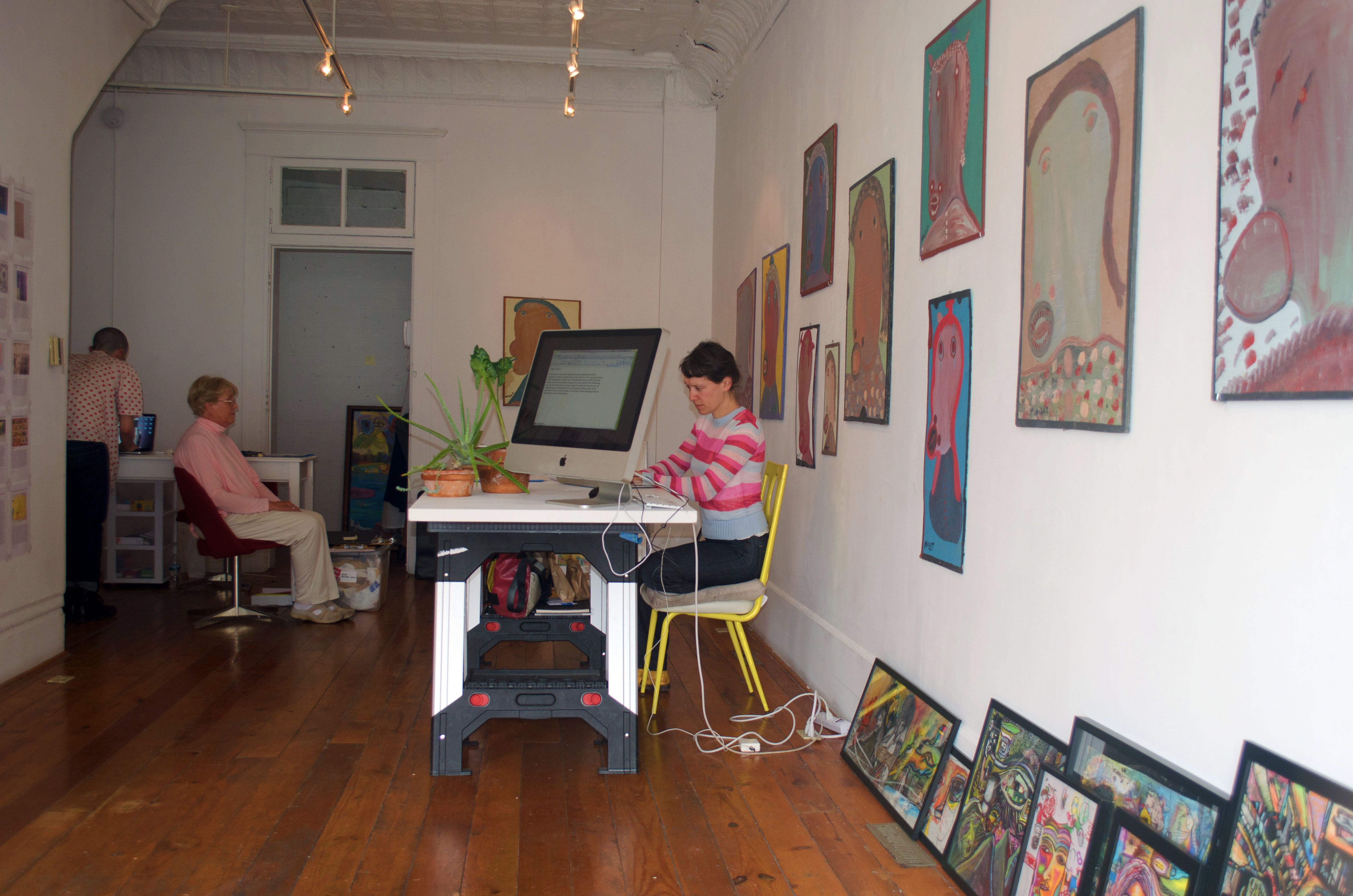
Performance in Documenta 13, Kassel Germany, summer 2012, photo by Claire Pentecost
Heather Jones

You’ve taken 60 wrd/min to many cities and major events like dOCUMENTA (13) over the course of the project’s existence. What was the initial idea for the project – what sparked this idea in your mind? And how has the project evolved over the many years you have been working with it?

Lori Waxman

The idea came to me when I was myself emerging as an art critic, and my friends and partner were all emerging artists. Everyone wanted reviews but the process for getting one was quite oblique. Likewise, I wanted to publish them! My day job at the time was in art book publishing, and it included writing thousands of words of text, on short deadlines, about forthcoming art books. I got very good at being intelligent, original, and fast when writing about art. So I just put all of that together and asked, What if I wrote reviews for anyone who wanted them, but with the caveat that they would have to be done quickly, so that everyone could get one. Would they still be worthwhile? It turned out the answer was yes.

Would they still be worthwhile? It turned out the answer was yes.
Lori Waxman

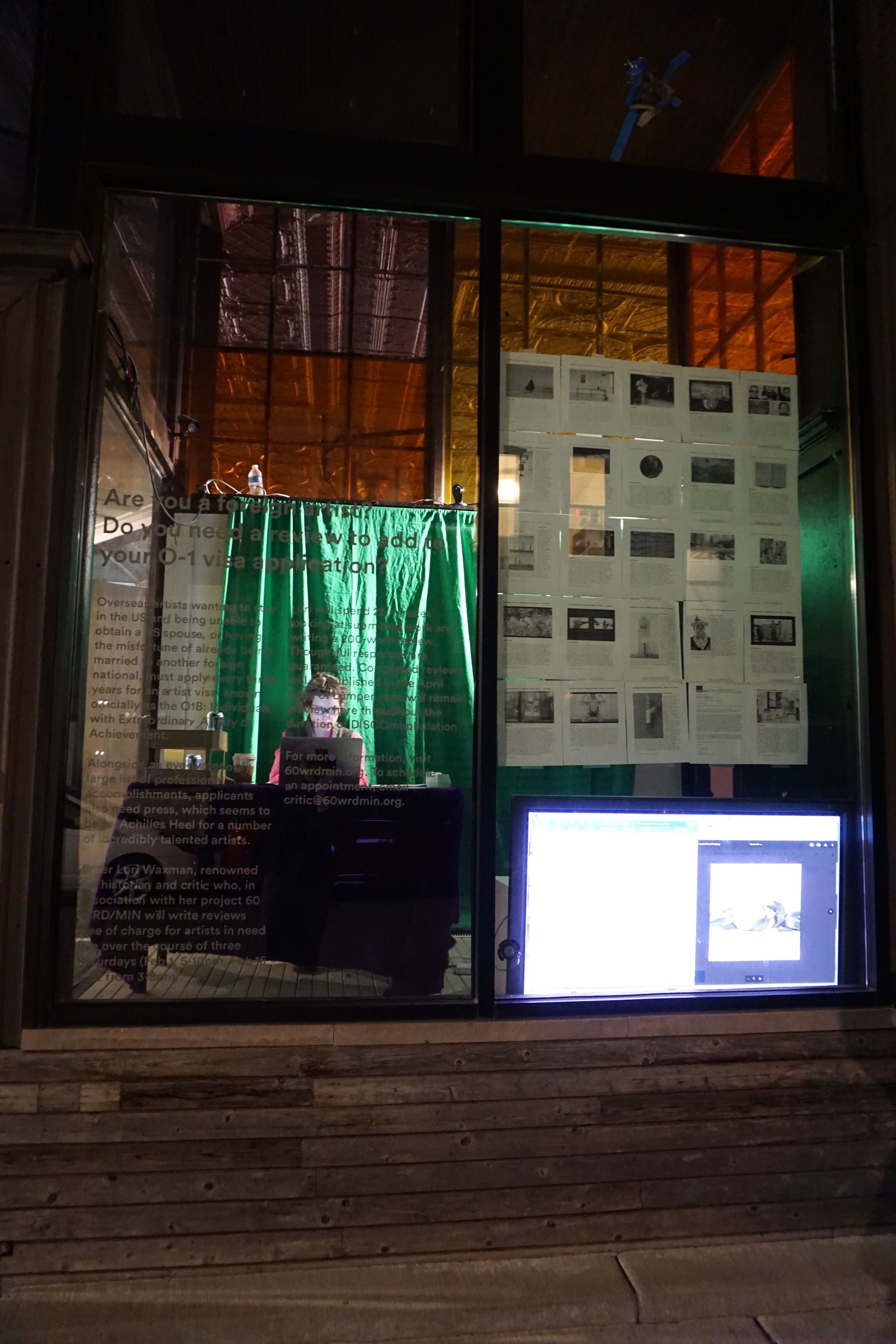
The process has not changed radically over time except that it has gotten more streamlined. I now have a very orderly, consistent system in place. What has changed is my understanding of the different needs that artists have and that these reviews might be expected to serve. Some of those needs demand special attention, and so I have done versions of the performance open only to select participants, for instance incarcerated artists, foreign artists needing reviews for their visa applications, and artists whose shows were canceled during the covid pandemic.

Lori Waxman. Photo: Private
Heather Jones

The project is often framed as a democratic gesture, with “brief, serious reviews to all artists on a first-come, first-served basis.” How does making criticism available on demand affect ideas about who gets to critique art and who gets to receive a review?

Lori Waxman

It doesn’t do much to change ideas about who gets to critique art — it’s me, always me, and I’m unapologetically an expert — but it does try to spread that critique around to all sorts of artists, from the amateur to the professional, the hobbyist to the child. The idea there is that all art and artists can potentially benefit from open-minded, thoughtful, informed critique, and so I try to make it more widely available than it usually is.

The idea there is that all art and artists can potentially benefit from open-minded, thoughtful, informed critique, and so I try to make it more widely available than it usually is.
Heather Jones

You will be in Stavanger 16-18 March, writing reviews in 25 minute sessions. At other times, you have written reviews for months on end. How do you deal with the fatigue of viewing and reviewing so many artworks in succession … or is one of the conditions of an art writer that the performance reveals?

Lori Waxman

Like I said, I now have a very good system in place. That includes scheduling the performance for a duration and in increments that I can sustain. I definitely get a one-hour break in the middle of each performance day. Normally the performance is three days long, and it’s alright if I am burnt out by the end of it. I usually am. The problem was when I did performance for all three months of Documenta. I burnt out bad after the first two weeks and had to adjust my schedule so that I would make it through to the end of the exhibition, intact and with quality reviews in my wake.

Performance at Institute 193, Lexington, KY March 2017, photo by Maia Ferrari
Performance at Co-Prosperity Sphere, Chicago Feb 2020, photo by Li-Ming Hu
Heather Jones

It’s interesting that this event is framed as a performance: the artist and the critic are performing their roles in front of each other, in an extremely condensed timeline. It sounds extremely stressful! In setting it up in this way, are you reflecting on the performativity of the artworld in general? How do you work within the constraints you’ve given yourself?

Lori Waxman

To clarify, artists are not necessarily being asked to perform. They have a lot of leeway in terms of how they present themselves and their art. If they are uncomfortable with the live theatricality of the project, they can drop their work off ahead of time, or send someone to drop it off for them. They are invited but not required to be present during the time their review is being written. I am genuinely not trying to stress them out. As for me, I admit to enjoying the pressure quite a bit. It’s a little bit thrilling, to do something normally hidden out in public.

I am genuinely not trying to stress them out. As for me, I admit to enjoying the pressure quite a bit.
Heather Jones

In Stavanger, the critiques will be published locally during the run of the project. What does it mean to you to work with a regional arts community here? What do you hope artists and audiences gain from this project in Stavanger specifically?

Lori Waxman

It is the same goal in any regional arts community, most of which struggle to maintain robust gallery scenes and review columns. I hope to offer a few days of having both, and to suggest the richness that can come from that. I don’t know much about Stavanger, as I purposefully never know much about the art scenes I am to visit. It is up to the host to determine that the project would be locally welcome and worthwhile. Then I just show up and do the job.

Heather Jones

Across different cultural contexts – U.S. vs. Europe, or small cities vs. larger art world centers – have you noticed differences in how artists approach receiving critique?

Lori Waxman

I can’t really answer the question, as with a very few exceptions earlier on, the project almost exclusively takes place in regional arts communities. In such places, it has proved more interesting (far more diverse participants, as opposed to all professional) and also useful (because they are less likely to have any local art critics).

When I was done, I looked up and noticed his mother was crying.
Heather Jones

Do you have any particularly memorable moments in which an artist responded to your review in a way that changed how you think about the project, or your practice in general?

Lori Waxman

There was a family that visited me at Documenta, to present the abstract paintings of their son, who was in his mid-20s. He was severely autistic and practiced art daily at a studio for adults with developmental disabilities. I took his work very seriously and wrote about it as such. When I was done, I looked up and noticed his mother was crying. I was horrified to think I’d upset her, and I went over to speak with her. She told me she was crying because the review was a validation of their parenting, and of the young man’s place in the world. That has stayed with me for a very long time.


More info

Lori Waxman: 60 wrd/min art critique

Stavanger kunstmuseum / Sølvberget

16 – 18 March 2026

Lori Waxman, born in Montreal, Canada, writes monthly columns for the Chicago Tribune and Hyperallergic. She teaches art history and criticism at the School of the Art Institute of Chicago and has a Ph.D. from the Institute of Fine Arts, New York University. Her book Keep Walking Intently (Sternberg Press, 2017) offers a history of walking art in the 20th century and was recently re-released in an ebook edition. In 2018 she was awarded a Rabkin Prize.