Exploring the visual art scene of Norway's southwest coast ➜ Since 2015
It’s really about bombing
In this edition of our Impact / Inntrykk series – personal texts remembering a single artwork – CAS International Editor Heather Jones recounts her first time seeing 5000 Feet is the Best by Omer Fast. As the former wife of a US Army soldier deployed to Iraq, the video work made her question: What can art do, if its audience is refusing to see what the work is trying to show?
Omer Fast, '5000 Feet is the Best', 2011, film still
The day my then-husband returned from his tour of duty in Iraq, the US Army sat Charlie Company 2/7 CAV down for a mental health debriefing that consisted of two directives: Don’t drink and drive and don’t beat your wife. They then gave each returning soldier a keychain with a bottle opener that read “skill + will = kill”.
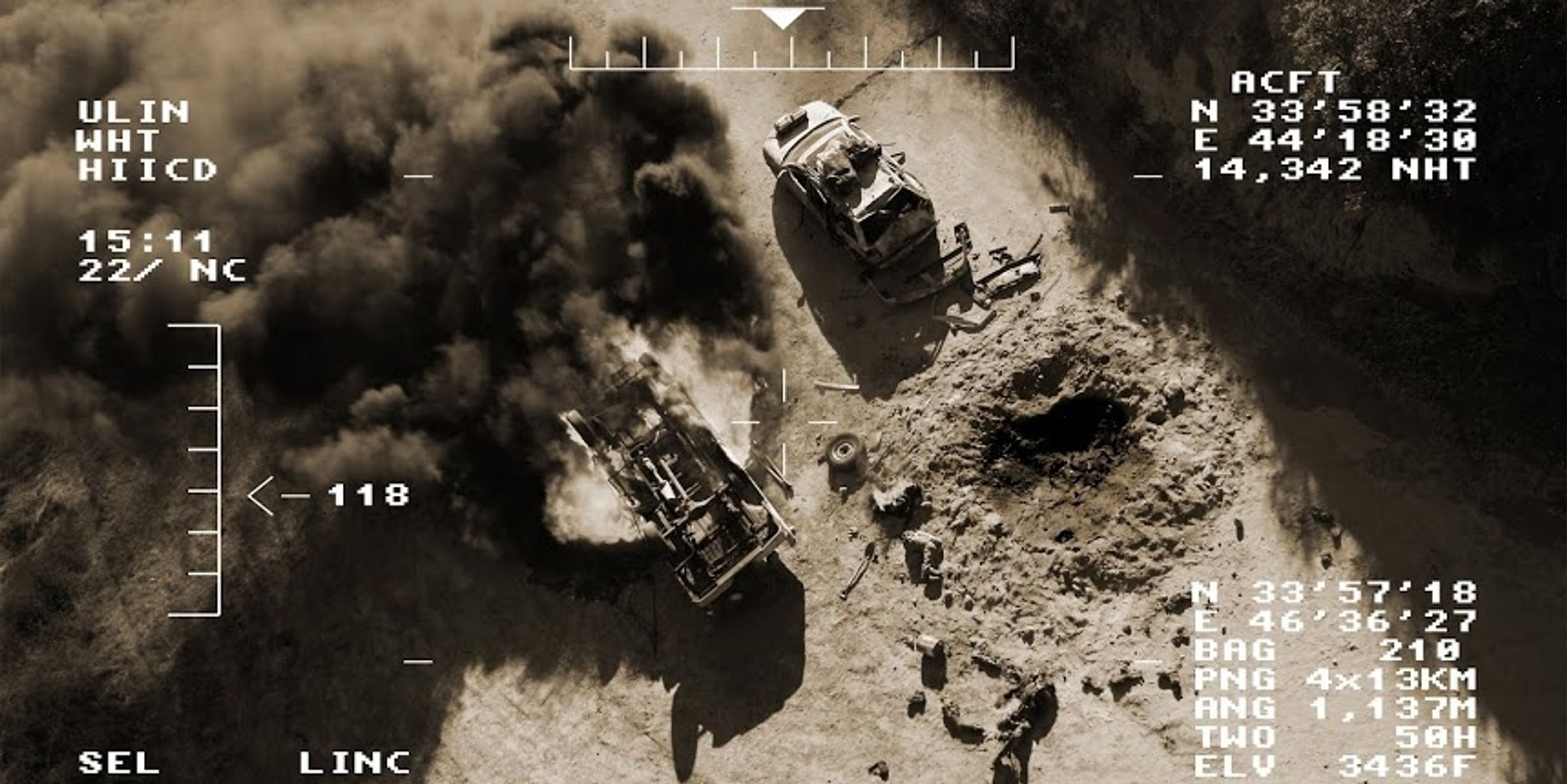
Nearly a decade later, on a cold February day in 2013, I sat as an audience member in a small theatre at a preeminent Scandinavian art museum listening to a conversation between the museum’s curator and the Israeli-American artist Omer Fast, following a screening of Fast’s 2011 video 5000 Feet is the Best. The 30-minute video work is based on a series of interviews Fast conducted with a drone operator who served in the US military during the Iraq and Afghanistan wars. The video moves between the operator himself (face blurred) and an actor hired to re-enact the interview in a hotel room.
Two directives: Don’t drink and drive and don’t beat your wife.
In the interview, the operator describes the personal experience and effects of operating a drone. It takes three tries, the first two veering off into seemingly unrelated stories.
The loud beeps, the repetition of scenes that are almost but not quite the same, the references to doctors appointments, the flinching, the headaches, the rattling of pill bottles, the constant question, “Are you ok?” – it all serves to illustrate the fracturing of the mind and the body. The operator insists he is ok, and instead describes the process of operating an armed drone:
“5000 feet’s the best. We love it when we’re sitting at 5000 ft. At 5000 ft, I can tell you what type of shoes you're wearing. (...) There's a horror to working Predator. You see a lot of death, like I said, I can see what type of shoes they’re wearing. It’s pretty clear about everything.”
Heather Jones. Photo: Carlos H. Juica
There are mentions of Iraq, Afghanistan, and Pakistan but it could be Iran, Gaza, Ukraine… and so on. The dialogue is interspersed with idyllic flyovers of American towns. You can see houses and church steeples, maybe a school. There in the theatre, I realized, it’s my landscape, my home. I felt a sickening unease at the idea of an armed drone flying over my childhood house, my school… How would it feel to live under the threat of becoming collateral damage?
There in the theatre, I realized, it’s my landscape, my home.
In the video, the operator goes on to describe a Mom, Dad, and two children packing for a weekend trip, and the video shows a typical white American family in suburbia packing a station wagon. But it’s confusing; there’s mention of trouble with the provisional authority, stopping at checkpoints. Reality blurs and the tables are turned. The family, and the men they eventually encounter digging an IED (Improvized Explosive Device) into the road, are all white, middle-class Americans. The voice-over describes one of the men wearing a headdress typical of the South while showing a man in a baseball cap, and I snickered despite myself. Inevitably, the family and the men are all hit by a hellfire missile. The voice of the operator describes the clinical administrative process for firing a hellfire missile, including the laser targeting marker affectionately referred to as “The Light Of God.”
“It looks like a light coming from Heaven. It’s quite beautiful. It didn't quite impact me that, hey I just killed someone. It was later on, through a couple more missions, that the dreams started.”
As an American, recently separated from my infantryman husband, the video had a visceral effect. Too familiar was the cadence of the operator’s answers, the repetitions, the slides to the side, the clean lingo (target instead of person). Too familiar was the conflicting coexistence of the violence he described and the personal trauma it caused, with the casual ease of it all.
Afterwards, of course, there was coffee. Death, Destruction, Snack Break.
During the talk with Omer Fast, the curator employed by the preeminent Scandinavian art museum asked intellectual questions about the drone representing distance in artistic practice, subjectivity, and experimental film techniques. Several times Omer Fast graciously replied with something like “You could see it that way, but it’s really about bombing,” or “It’s really about the violence of war and its psychological dissonance.” I was frustrated looking around the audience, listening to the curator’s questions, and thinking, “Why are we talking about art theory and curatorial distance when we should be talking about US aggression, violence against civilians, and psychological trauma? Am I the only one in this room touched by war, in some way or another?” Afterwards, of course, there was coffee. Death, Destruction, Snack Break.
Omer Fast, '5000 Feet is the Best', 2011, film still
It’s now 2026. Fast’s critical and emotional investigation of drones, the bombs they carry, the people operating them, and the people they kill is more relevant than ever. It makes me question what art can actually do, particularly if certain audiences are unwilling or incapable of engaging with the work without a personal frame of reference. You can intellectualize all you want, but at the end of the day, “it’s really about bombing.”
At the end of the day, it’s really about bombing.
But maybe the video doesn’t just serve the audience. 25.16 minutes into the video, right after the hellfire missile destroys the family’s car, there’s a pause and then the family continues their journey. We watch the family get out of the bombed sedan – bloody, soot-covered, but alive – and walk into the distance. The mother puts her arm around the young girl. This moment, fictional though it may be, grants a different outcome to the victims. I know it’s not real, but it feels powerful and necessary to deny, in any way we can, the god-like power of the hell-fire missiles, the drones, the operators and the political powers that administrate such violence.
About the author
Heather Jones is an American writer and curator currently based in Sweden. She is a one of the founders of CAS – Contemporary Art Stavanger, and its International Editor. Jones was recently appointed Curator of Exhibitions and Collections at Kalmar Konstmuseum.