Exploring the visual arts scene of Norway’s southwest coast ➜ Since 2015
Made to be Touched
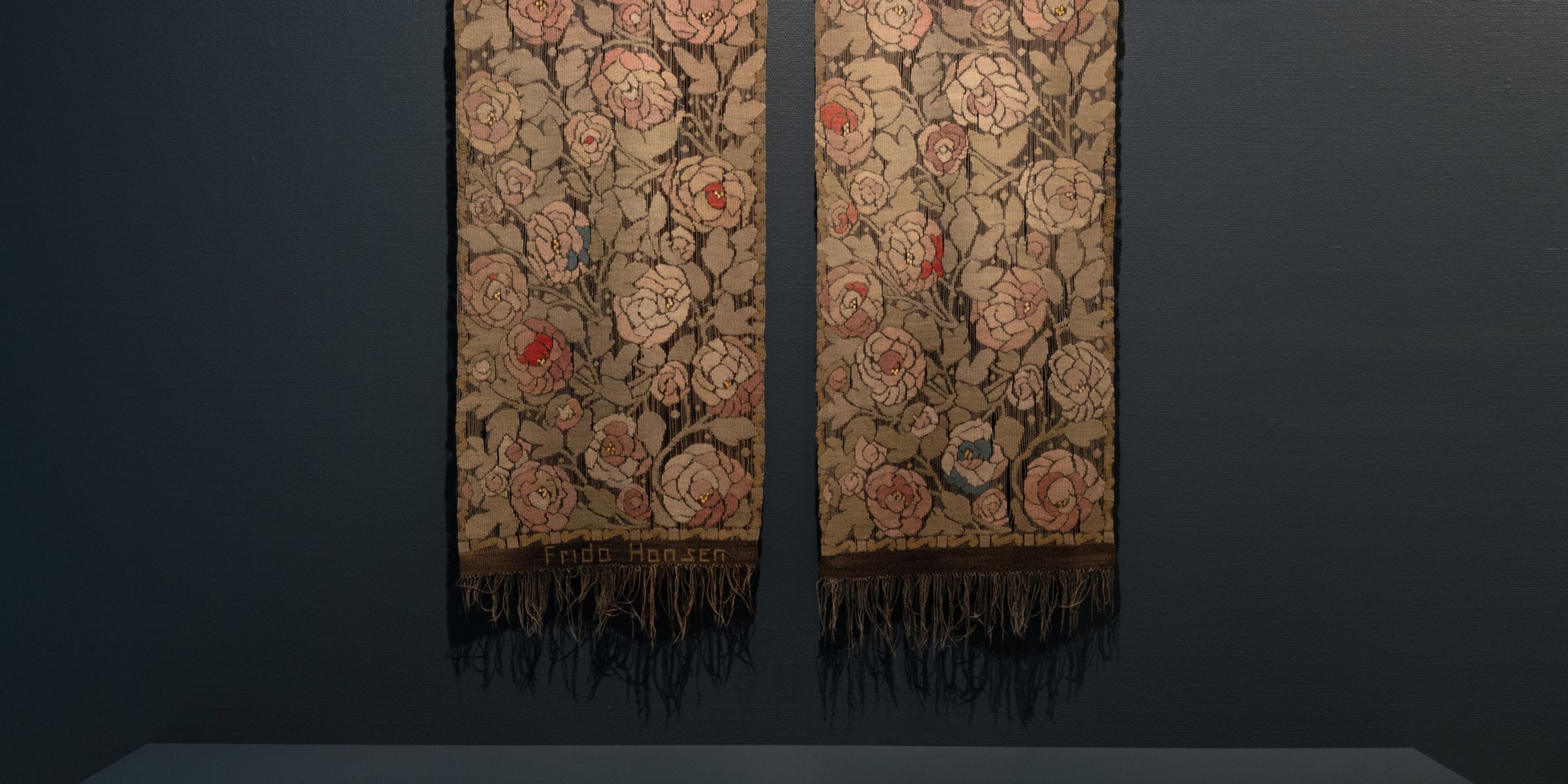
In the newest edition to our Impact / Inntrykk series – personal texts remembering a single artwork – Stavanger-based artist Hans Edward Hammonds reflects on the textile work Peoner by Frida Hansen. A display of the fragile tapestry, currently housed in the collection of Stavanger Kunstmuseum, reminded Hammonds that it was originally made to be lived with, and that revelation has continued to influence his practice ever since.
Frida Hansen, Peoner, circa 1928. Image: Stavanger Art Museum / Oddbjørn Aarstad Erland.
I did not know the word portiere or ever considered its function before I saw Frida Hansen's work Peoner (c. 1928). As it turns out, this historical pictorial tapestry would change the way I approached my own art practice.
I was fortunate enough to work as a technician and guide at the Stavanger Art Museum in 2015 when they launched the Frida Hansen exhibition Art Nouveau in Full Bloom. It was the largest showing of Frida Hansen’s work in 40 years, and more than that, her works were coming home. At the time I had not heard of her and to me it was just another historical art exhibition. As soon as we opened the first crate and started unrolling her tapestries, I understood that this exhibition was something out of the ordinary. Although affected by time, her works were delicate, beautiful and packed with history. I sensed the excitement from all the curators, art historians and conservators frequently coming in to check and observe the artworks.
Yet Hansen's tapestries called to people to reach out their hand and grasp the textile works.
The process of being a technician brought me really close to her work, and through the time I spent there, I learned much about her life and the time she lived in. So when the show finally opened and I went from being a technician to being a guide, I was fully ready to mediate the show. However I was not prepared for how the audience would engage with the exhibition, not only the excitement, but also their need to physically handle the artworks. I remember several times having to politely ask visitors not to touch the artworks. I knew they would never touch the paintings by Lars Hertevig or Kitty Kielland as everyone knows that would be a huge taboo. Yet Hansen's tapestries called to people to reach out their hand and grasp the textile works. The older members of the craft communities were the worst offenders. I can remember rushing over to them politely and sternly whispering “you can't touch the artworks”. I could see their faces going from bewildered to embarrassed as they themselves realised what they were doing and the context they were in. I felt conflicted doing this, because I get it. Frida Hansen did not make these works to be hung in a museum. They were made to be beautiful, tell stories and to be functional pieces of art in a home, business or in a public space. They should be read as works of art integrated into daily life.
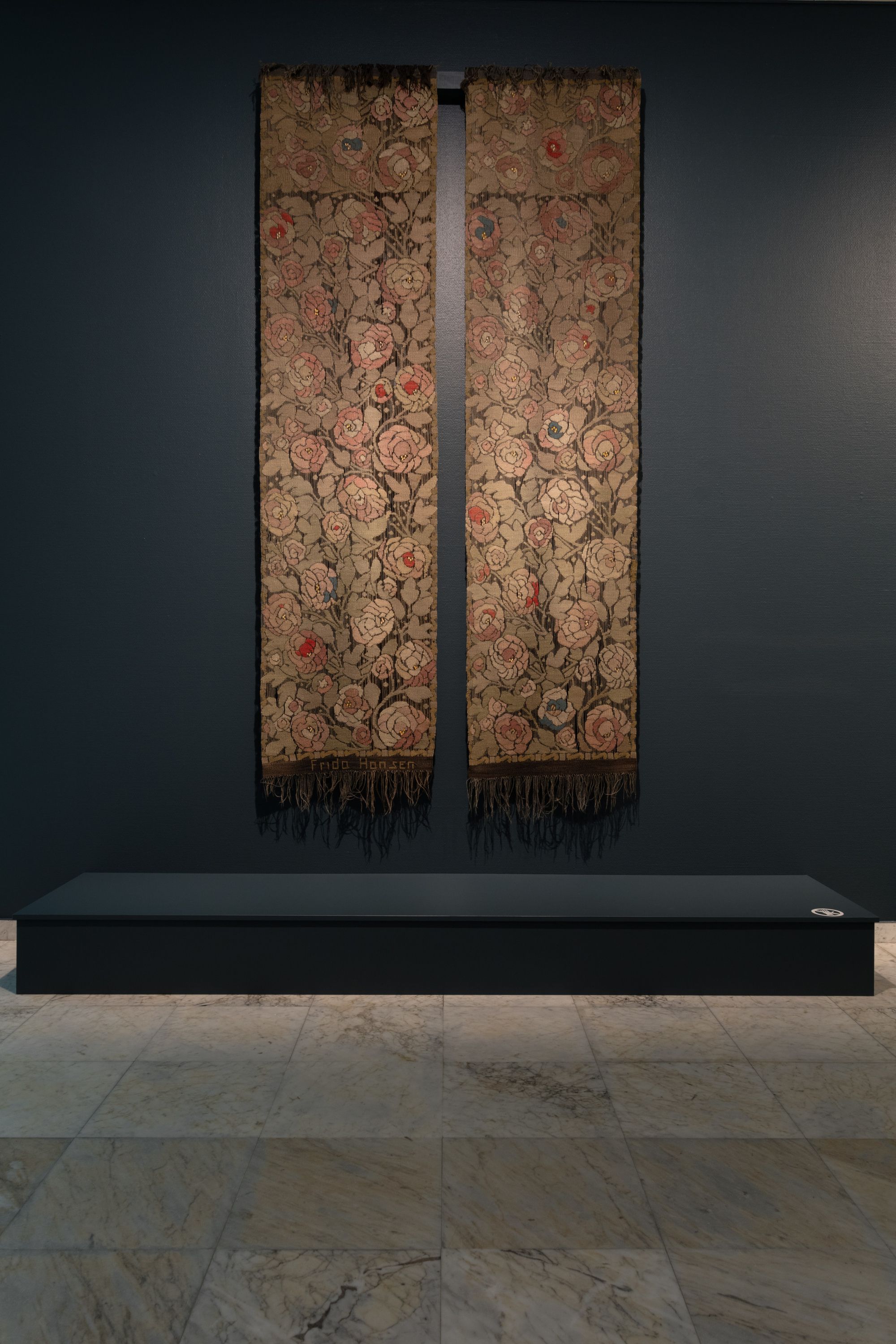
Frida Hansen, Peoner, circa 1928. Image: Stavanger Art Museum / Oddbjørn Aarstad Erland.
Hansen's work Peoner is a perfect example of a practical artwork that invites us to touch and engage with it. This brings me back to the word portiere, which is typically defined as a curtain hanging in front of a doorway. Peoner is a portiere made up of two delicate, partially transparent woven panels depicting peonies. At the museum they are presented flat against the wall, but they were never intended to be shown in this way. They were supposed to hang in a doorway like a portal that lets light, movement and sound from one space into another while at the same time dividing the spaces. They were made to be looked at, looked through, and also to be passed through, letting the soft woven threads move across your skin and body. It's truly an artwork for all the senses. The museum has to protect these old and fragile works from both touch and light in an effort to conserve them for the future. And I do understand that it's the museums job to do so, but in a sense, through the action of conservation, the true meaning of the work is taken away.
The experience had an immediate impact on me. As an artist, I knew right away that I wanted to make work that encourages participation and tactile engagement. But it's taken me time to understand how. I guess I still don't know, even though it's been a decade since Hansen’s show. Since then, my practice has become a series of artistic attempts to find ways people can engage with my art – through seeing, but also by doing, feeling and activating all the senses. Since my encounter with Peoner, I have wanted to make art that is always in motion and in physical connection with the world and the people in it.
Since my encounter with Peoner, I have wanted to make art that is always in motion and in physical connection with the world and the people in it.
About the author
Hans Edward Hammonds is a Norwegian and New Zealand artist. He holds a Master of Fine Arts from the Elam School of Fine Arts (University of Auckland) in New Zealand. Hammonds has a multi-disciplinary practice that includes sculpture, installation and participatory projects. His work is playful and explores collaboration and interaction. Hammonds believe these are urgent working methods with which to engage in the current social and political climate.