Exploring the visual arts scene of Norway’s southwest coast ➜ Since 2015

Thresholds for Connection: A Conversation with CAS Resident Sarah Kazmi

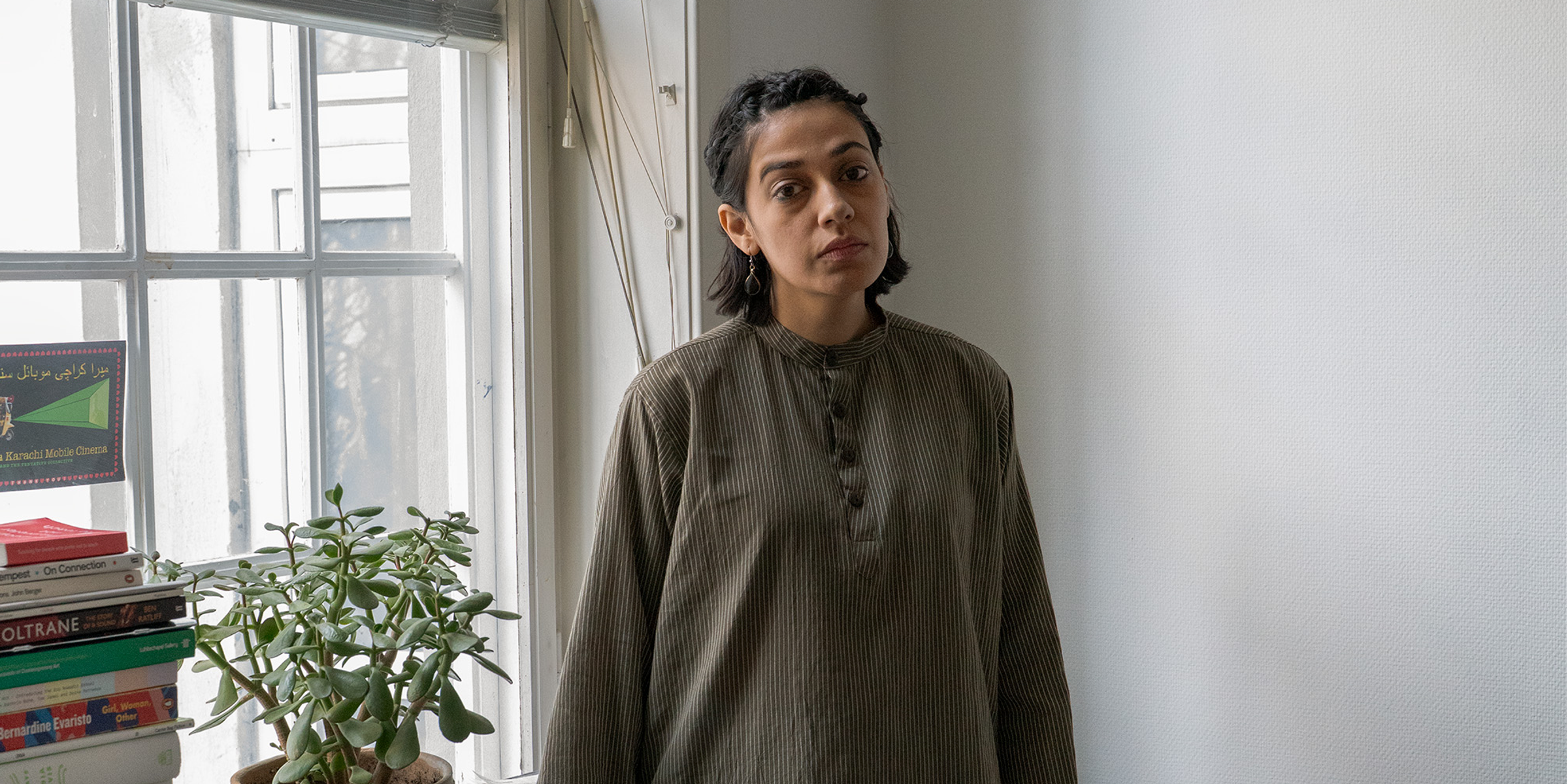
CAS is thrilled to welcome Sarah Kazmi to the 2026 CAS Residency in Art Writing. Kazmi is an interdisciplinary artist from Karachi, Pakistan whose artistic practice is rooted in research, writing, visual art, and performance. Kazmi is visiting Stavanger as a part of her ongoing artistic research project Visnings, which takes a critical and intimate look at the wave of emigration from Norway to the United States in the 19th and 20th centuries.

Photo: Julie Lauritzen
Heather Jones

You have a multi-disciplinary practice that includes archival research, performance and participatory events, video and sound, installation, writing, and more. Could you briefly describe your background and how you came to work within contemporary art?

Sarah Kazmi

I remember back in 2014, how nervous and scared I was to write, let alone write a dissertation... but in these past years, it's my dissertation I keep coming back to. The text explores the role of food as an artistic medium in contemporary art. It addresses questions like: How does food reduce the gap between viewer and the artwork? And consequently, how does it blur the distinction between the artist and the participant? This writing process significantly influenced my practice, guiding my work through various mediums, people and places. After graduation, I primarily worked as a researcher for various collectives and research-based projects which led me to place my artistic practice in constant dialogue with society.

This approach shaped my artistic practice towards working with the language of locality; and I believe that in that moment of questioning and confusion about what art is or can do, I arrived at my very own definition of contemporary art and who/what I want to work with/around/for.

Heather Jones

In your work Cooking, Time, you explored Pakistani labor migration to Norway. You’re now working on the project Visnings, which looks at migration from Scandinavia to the United States. Can you tell us more about this project?

Sarah Kazmi

It is quite absurd how the project Visnings began when I think about it now. While researching for my project ‘Cooking, time?’ I found a document in sociologist Aud Korbøls archives titled Capital and cultural hegemonism: A historical overview of the "foreign element" in Norwegian society, where I was primarily looking only at the labour migration from Pakistan (Kharian) to Norway. However, I couldn’t resist making a copy of the document and here I am today, looking at the Norwegian emigration to the US. You see, this paper offers a historical analysis of certain socio-economic aspects of the indigenous Sami and foreign workers’ situation in Norway. And it begins by exploring the implications of concepts like “homogeneous society”, using Edward Said’s idea of “flexible positional superiority” to examine the “foreigner’s” relationship to dominant Norwegian society. Departing from here, I am looking at both the agrarian capitalism, and the growth of industrialisation’s effect on labor migration to and from Norway.

Focusing on the transitional movements involved in the Norwegian emigration to the US via the UK in the 19th - 20th century, I am looking at this 'nomadic' journey through the interplay of nature, technology, and different belief systems. Deleuze and Guattari point to the idea of 'nomadism' in A Thousand Plateaus, when they write: «History is always written from the sedentary point of view and in the name of a unitary State apparatus, at least a possible one, even when the topic is nomads. What is lacking is Nomadology, the opposite of history.» Following this, the people that move become strangers or estranged – they are immigrants and emigrants, defined by their reason for leaving and their ability to adapt to their new surrounding culture of stillness. To refuse stagnation and remain nomadic, is to be an eternal stranger to society, to be forever in transit.
In the current geo-political climate, I have been thinking a lot about thresholds. Some can divide us if we permit them. There is also a profound opportunity to transform divisions into thresholds for connection.

Heather Jones

How does this project bring you to Stavanger?

Sarah Kazmi

The inaugural vessel to depart from Stavanger bound for North America was christened the Norse Mayflower, a name derived from the English Mayflower, a merchant vessel that brought the first English Separatists, known as the Pilgrims, to the New World in 1620. The Norwegian Mayflower also known as the “slooper”or restoration, was a journey also made for religious quest amongst other things. This part of history brings me to Stavanger, to look more at stories surrounding this journey, to speak with the local people and visit important places that could inform my research. Also the project is very nomadic in its nature, and I am convinced an iteration of it may take its form somewhere in Stavanger.

Heather Jones

What is the impetus or driving force behind this current project for you? Why here, why now?

Sarah Kazmi

In the current geo-political climate, I have been thinking a lot about thresholds. Some can divide us if we permit them. There is also a profound opportunity to transform divisions into thresholds for connection. The term threshold originally referred to the doorway leading to the threshing floor, the place where grain was sorted, sifted and separated. To cross a threshold was to move from one space to another, from one way of being to the next. Anthropologists describe such moments as liminal from the Latin word limen meaning threshold. With this backdrop, I am approaching the port as a transit, a liminal space; in-between spaces: between identities, between stories and between the life yet to be born. The boat is that floating piece of space, a place without a place that exists independently and at the same time is given over to the infinity of the sea.

Norwegian maritime migration produced and circulated sanctuary narratives through transnational networks of seafarers, religious institutions, and communication systems. These narratives facilitated physical migration and spiritual integration into a dispersed international community of believers. Today, they are reactivated through heritage tourism and digital technologies, where nature and landscape serve as experiential anchors for identity and memory.

Researching Norwegian emigrants’ stories and migration routes reveals a growing convergence with Pakistani labor migrants a century later. This shared narrative informs my interest in this work, focusing on Norwegian and other seamen’s experiences at the port and beyond. I am also very much looking forward to being able to display the preceding chapters of Visnings as an exhibition altogether in the near future.

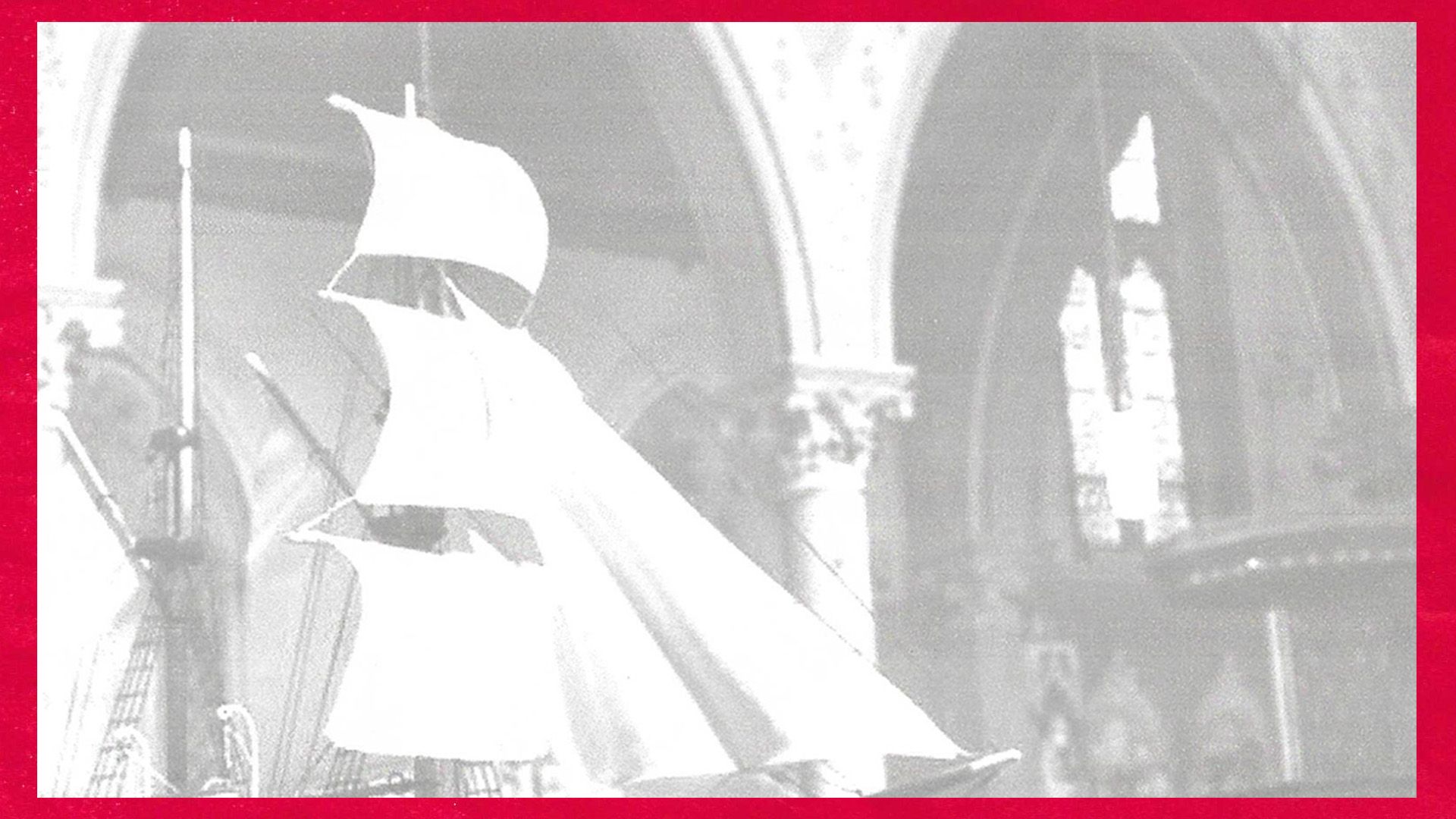
Sarah Kazmi, Prayer sailing to God, 2026. Collage. Photo: Nathan Taylor / archives
Heather Jones

Visnings is quite a sprawling project both in terms of content, location, and output. What is your research method, and how does that transform into creative production? Do you already know what form this project will take – text, performance, installation?

Sarah Kazmi

Two individuals have contributed to my understanding of what research is and its appropriate approach over the past two years. Harald Gaski’s lecture last year titled Gullat, guldalit: to hear, to listen, and to act accordingly - Sámi values, views, and understandings explored the relationship between research, art and emotions. He presented a conceptual model of a triangle representing connections, divinity and the merging of opposites. Shawn Wilson’s Research is Ceremony describes research as a shared journey in which the researcher connects with knowledge, participants and the community. It is a process of building and maintaining relationships with the world. Therefore, I can say that research for me is a cultural practice that incorporates storytelling, conversations and personal interaction rather than relying solely on objective, linear and detached methods.

Due to the nature of the project, I anticipate multiple iterations which may take new forms, both in institutional and public spaces. At present, I envision a sound installation, drawings, sculpture, text and performance. Alongside material manifestations, public programming is an essential component of my exhibitions. Consequently, we will be conducting workshops and other activities in the towns of Lesja and Selbu in collaboration with local community members.

Research for me is a cultural practice that incorporates storytelling, conversations and personal interaction rather than relying solely on objective, linear and detached methods.
Heather Jones

What is your next step in the developing Visnings after your stay in Stavanger?

Sarah Kazmi

Following the CAS residency, I will premiere a new performance work at Kunsthall Trondhiem in late September. I will also produce an eight-channel sound installation with various mediums and a zine for the Karachi Biennale in January 2027 which will also be exhibited at Lydgalleriet in 2027. In addition, I am planning workshops and performances at Kolstad Farm in Lesja and Selbu in the summer of 2027. This will be followed by a live performance at the Scandinavian Seamen Church in Liverpool and potentially the Norwegian Seamen Church in London.

About the author

Sarah Kazmi is an interdisciplinary artist from Karachi, Pakistan. Her artistic practice moves across research and visual production, observing the relationship between food, language, and politics; often based around/with communities and local environments. In addition to visual artworks Kazmi works with writing, as her texts are often conveyed through a variety of rhythmic disciplines including sound, video, installation, and performance.

Alongside her artistic practice, Kazmi has worked with policy advocacy for Verdensrommet (2021–), an artist-powered support network by and for non-EU/EEA creative professionals in Norway. She was a participating artist at the 2025 Skowhegan School of Painting and Sculpture (US). Her work has circulated both locally and internationally, more recently at Colomboscope (Srilanka), Bergen Assembly (Norway), Raven Row (UK) and Oslo Intercultural Museum (Norway). Sarah's work has been supported by institutions such as Office for Contemporary Art and KORO (Public Art Norway) and Arts and Culture Norway. She is currently a beneficiary of the two-year free studio programme at Atelier Kunstnerforbundet, Oslo.

All articles by Sarah Kazmi